
The retail shelf is no longer just where products sit and prices are displayed. As physical stores become more connected, the digital shelf edge is evolving into a real-time interface for pricing, product information, promotions, brand communication, inventory signals, and store operations.
This shift matters because the shelf occupies a unique position in the shopper journey: it is physically close to the product and close to the moment of decision. Instead of separating merchandising, advertising, pricing, and operations into different systems, smart shelf technology can bring them together at the shelf itself.
For retailers, the result is more than a digital replacement for paper labels. A connected shelf edge can become part of a broader in-store retail media network while simultaneously supporting more accurate and efficient store execution.
That combination—media value plus operational value—is what makes the shelf edge increasingly strategic.
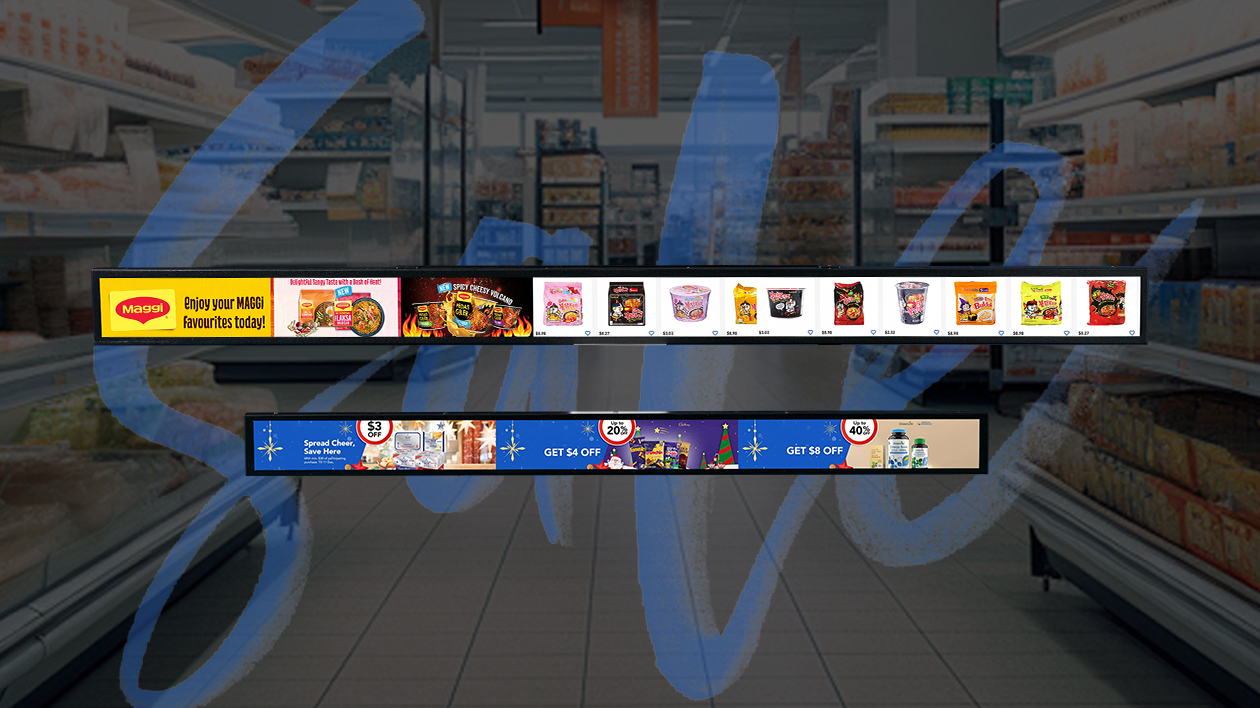
Historically, shelf-edge infrastructure had a narrow job: identify a product and display its price. Promotional messaging was typically handled elsewhere through printed shelf talkers, posters, endcaps, or larger signs.
That model is changing because the role of the physical store itself is changing.
Despite the growth of ecommerce, stores remain central to retail. Deloitte's 2025 Retail Industry Outlook reports that approximately 80% of shopping still happens in physical stores, while 47% of surveyed shoppers agreed that digital screens positively affect their in-store grocery shopping experience. Deloitte also identifies enhanced physical stores and shoppable media among the areas retailers are exploring as they look for more profitable, personalized interactions.
At the same time, retail media investment is moving closer to the transaction.
IAB Europe's Attitudes to Retail Media Report 2025 found that the share of respondents prioritizing the ability to reach shoppers at the point of sale increased from 74% in 2024 to 79% in 2025. The same research found that digital screens now lead in-store retail media adoption: 70% of surveyed retailers offer digital in-store screens, while 54% of buyers invest in them. This changes the economics of the shelf.
A shelf edge does not have to function only as a static merchandising fixture. Once connected digitally, it can support product discovery, promotional communication, shopper education, retail media campaigns, and operational workflows—without moving the message away from the product being considered.
The shelf is therefore shifting from a display surface to an active retail touchpoint.
A digital shelf edge is the connected physical and digital infrastructure located along retail shelving that communicates real-time product, pricing, promotional, advertising, and operational information.
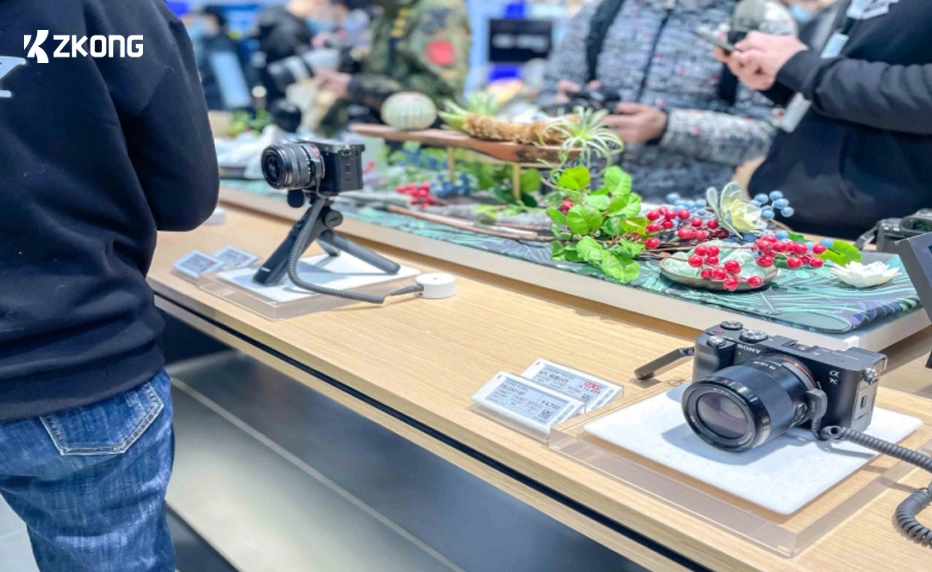
It can include electronic shelf labels, bar-shaped e-paper displays, shelf-edge LCD screens, LEDs, NFC or QR interactions, mounting rails, wireless base stations, cloud management software, and integrations with systems such as ERP, POS, PIM, inventory management, and content management platforms.
This makes the digital shelf edge different from a standalone screen.
A standalone digital display communicates content. A smart shelf edge can potentially connect that content to the specific product, price, promotion, inventory condition, shelf location, and business rule associated with that part of the store.
In practical terms, a connected shelf can operate across four layers.
At the data layer sit product, pricing, inventory, promotion, and campaign information. The cloud and software layer manages that data and distributes instructions. ESL and LCD devices form the shopper-facing communication layer. Rails, brackets, holders, base stations, power infrastructure, and other accessories create the physical deployment layer that keeps the whole system operational at store scale.
The real value comes from connecting these layers rather than treating each device as an isolated piece of hardware.
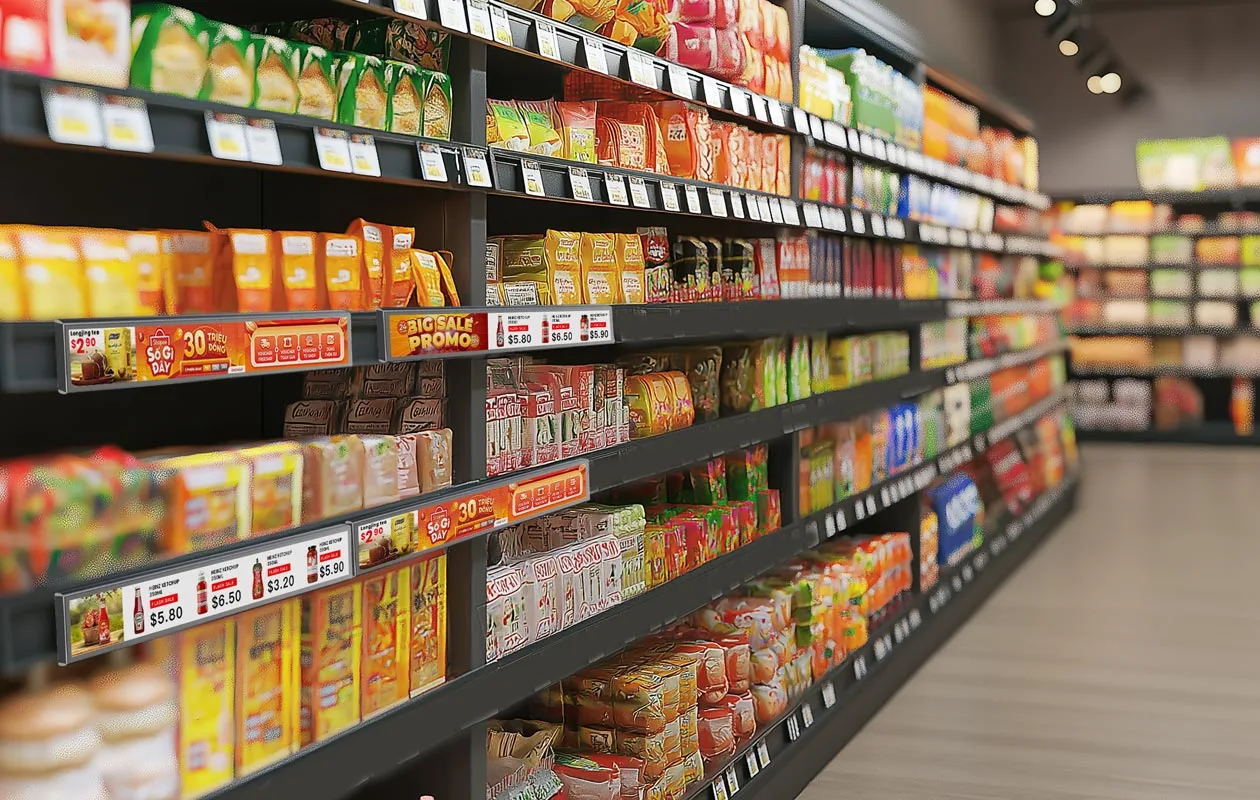
Electronic shelf labels initially gained attention because they solved a clear operational problem: replacing manually updated paper price tags with centrally managed digital displays.
That remains an important use case, but it no longer defines the full potential of ESL technology.
Modern electronic shelf labels can communicate more than price. Depending on the deployment, shelf-level information can include promotional offers, product specifications, unit pricing, membership pricing, stock information, QR codes, product origin, sustainability messages, and visual indicators for store employees.
Larger e-paper formats extend that communication space even further.
For example, the ZKONG Arrow Series ESL uses an elongated shelf-edge form factor suited to high-SKU and promotional areas, allowing retailers to organize richer product and promotional information directly along the shelf rather than treating each small price label as an isolated communication point.
This is where the distinction between a digital price tag and a digital shelf media surface begins to disappear.
The same shelf location that communicates transactional information can also reinforce campaign messages, highlight product benefits, distinguish private-label ranges, guide shoppers through categories, or support time-sensitive promotions.
The objective should not be to place more advertising everywhere. It should be to make shelf communication more relevant to what the shopper is trying to decide at that moment.
That principle is particularly important as in-store retail media grows.
IAB Europe's 2025 research summarized the transformation succinctly through Alison Dunham, Sales Director for In-Store Retail Media at PRN:
“In-store digital is so much more than cardboard, stickers and sampling.”
The digital shelf edge is one example of what that broader definition of in-store media can mean in practice.
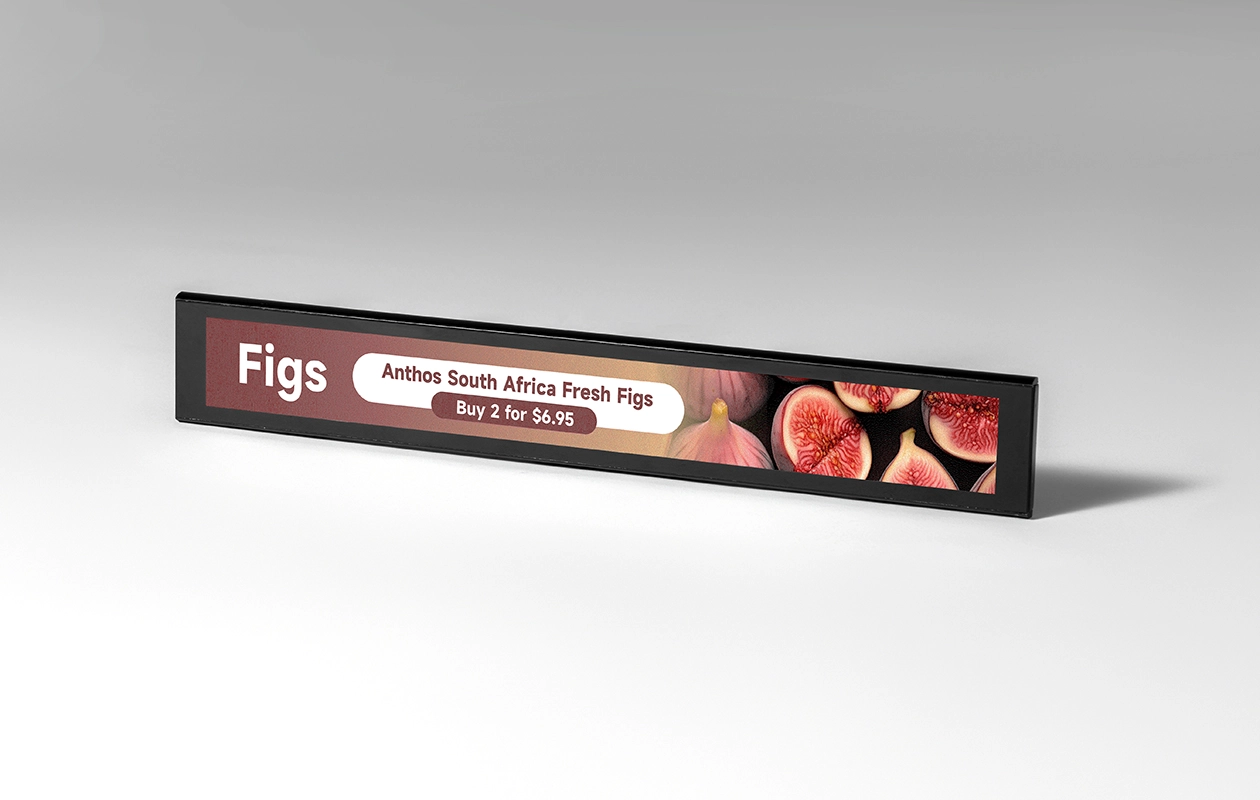
Traditional in-store advertising is often designed primarily for reach. Entrance screens, hanging displays, posters, and large-format signage can capture attention across a broad area of the store.
Shelf-level media performs a different role because its value comes from proximity and context.
Dimension | Traditional In-Store Advertising | Digital Shelf-Level Media |
Typical location | Entrance, walls, ceilings, endcaps | Immediately beside or beneath products |
Shopper stage | Awareness and navigation | Evaluation and purchase decision |
Product context | Broad category or campaign | SKU, category, promotion or shelf specific |
Content update | Often campaign based | Can be centrally and dynamically managed |
Operational role | Primarily communication | Can combine communication with pricing and store workflows |
Data relationship | Often campaign oriented | Can connect product, pricing, inventory and campaign data |
A digital display near the entrance might tell a shopper that a beverage promotion exists. A shelf-edge display can communicate that promotion when the shopper is physically comparing the relevant beverages.
That difference is fundamental.
Shelf media operates within the decision environment itself.
It can therefore complement rather than replace larger digital signage. Entrance and aisle displays create awareness; endcaps reinforce promotional themes; shelf-edge displays provide specific information where selection happens.
This is also why measurement discipline will become increasingly important.
A connected display should not automatically be treated as a measurable retail media network simply because it is digital. Retailers still need appropriate campaign governance, data connections, attribution rules, and reporting frameworks. IAB Europe highlighted this issue in 2025, noting that consistent, transparent and scalable measurement has become a major priority as retail media investment grows.
The strongest shelf media strategies will therefore connect location, content, transaction data and measurement, rather than simply adding more screens.
The digital shelf does not need one display technology to perform every task.
E-paper ESLs and LCD displays have different strengths, and their value increases when retailers deploy them according to the role each touchpoint needs to perform.
ESLs are well suited to information that must remain visible, accurate, and closely associated with a particular product or shelf position.
Price, product name, promotional price, unit price, stock information, QR codes, specifications, membership offers, and operational indicators are typical examples.
Because ESLs sit directly beside merchandise, they can provide the precision layer of digital shelf communication.

LCD shelf displays serve a different communication need.
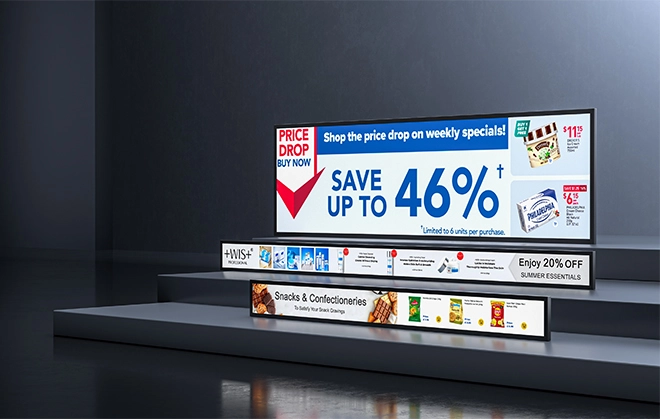
Full-color imagery, video, animation, campaign creative, product demonstrations, seasonal storytelling, and visually rich cross-selling messages are better suited to dynamic displays.
The ZKONG Legendary Digital Shelf Displays extend digital communication across the shelf edge through stretched LCD formats that can support centrally managed multimedia content.
Together, these technologies can create a connected communication journey.
A shopper may first encounter a campaign on a larger entrance display. A digital aisle display can reinforce the category message. A shelf-edge LCD can demonstrate the product or promotion visually. The ESL directly beside the SKU can then provide the exact price, promotion, specification, or QR interaction needed to complete the decision.
In other words:
LCD attracts and explains; ESL identifies and confirms.
For digital supermarkets, this combination is particularly relevant because grocery stores contain large assortments, frequently changing prices and promotions, high shopper traffic, and substantial opportunities for brand-funded communication.
The result is not simply more digital signage. It is a layered in-store communication system aligned with the shopper journey.
The biggest difference between a digital shelf edge and traditional retail advertising becomes apparent behind the screen.
A smart shelf is not valuable simply because the display is digital. Its value comes from the systems connected to it.
Pricing may originate in ERP or pricing software. Product descriptions may come from a PIM system. Inventory availability may come from inventory management software. Promotions may be defined by merchandising teams. Retail media content may be scheduled by marketing teams. Store employees may use LEDs or shelf information to support replenishment, picking, or product location.
When these workflows connect through a cloud platform, the shelf becomes an execution point for multiple retail processes.
Consider a promotion.
In a disconnected store, a promotion may require a pricing team to update a system, a marketing team to prepare signage, a store employee to replace labels, another employee to install promotional material, and later another round of work to remove everything when the campaign ends.
A connected shelf infrastructure can reduce those silos. Pricing information can be updated digitally, promotional templates can be scheduled centrally, LCD content can follow the campaign calendar, and shelf-level product information can remain synchronized with store systems.
The same infrastructure can also support operations that shoppers never consciously see.
Shelf LEDs can help staff locate products. Inventory integrations can expose stock-related information. Cloud management can allow a retailer to control devices across multiple stores. APIs can connect shelf systems with the retailer's existing technology stack.
This is why Smart Shelf Technology should be understood as a system architecture rather than a hardware category.
The relationship is important:
Retail Data → Cloud Platform → Smart Shelf Technology → ESL/LCD → Shopper & Store Operations
It connects concepts that are often discussed separately—retail media, dynamic pricing, store automation, digital merchandising, inventory visibility, and shopper engagement—into one physical retail infrastructure.
As retailers digitize thousands or even millions of shelf positions, hardware selection becomes only one part of the deployment decision.
A scalable shelf-edge system also depends on the physical and network infrastructure supporting those displays.
Rails and mounting systems determine whether ESLs can be securely deployed across different shelf types. Brackets, hooks, holders, and adapters make the system compatible with different merchandising environments. Wireless base stations provide device connectivity. LCD installations introduce considerations such as power delivery and cable management.
These elements may appear secondary compared with the displays themselves, but they determine whether a shelf technology can move from a pilot installation to a repeatable multi-store architecture.
ZKONG's ESL accessories and wireless infrastructure include shelf rails and wireless base stations designed to support ESL deployment across different retail environments.
The strategic question therefore changes from:
“Which electronic label should we buy?”
to:
“What shelf infrastructure do we need to connect products, content, pricing, operations, and stores?”
That distinction is important for large retail networks.
ZKONG's Carrefour smart shelf operations case, for example, describes an ESL deployment covering approximately 100 stores with around 10,000 ESL units per store, supported by centralized management for pricing, promotions, and product information.
At that scale, the shelf edge can no longer be viewed as a collection of individual labels. It becomes part of the retailer's digital infrastructure.
And that is ultimately where the future value of the digital shelf lies.
The shelf edge is one of the few physical touchpoints that can simultaneously connect the product, the shopper, the retailer's operational systems, and the brand's message. ESLs provide accurate and persistent product-level communication. LCD displays add visual storytelling. Cloud platforms coordinate content and data. Accessories and wireless infrastructure make deployment possible across real stores.
Together, they transform the shelf from a passive fixture into a smart retail interface.
As physical stores increasingly operate as connected media and commerce environments, the retailers that treat the shelf edge as infrastructure—not merely as a price display—will be better positioned to build stores that are easier to manage, more responsive to campaigns, and more useful to shoppers.


 Electronic Shelf Labels
  Digital Signage
  Cloud Platform
  ESL Accessory
  中文
中文 English
 日本語
日本語 français
 Deutsch