Electronic shelf labels (ESLs) and digital signage can improve pharmacy operations by keeping prices, product information, inventory data, and customer-facing health messages more accurate and easier to update. When connected with pharmacy management, ERP, inventory, or cloud systems, digital displays reduce dependence on manually replaced paper labels while giving pharmacy staff a more visible way to monitor products, locate items, communicate shortages, and keep shelf-level information synchronized.
This matters more in pharmacies than in many other retail environments. A supermarket pricing error may create inconvenience; incorrect or outdated medication information can create a much more serious information-management problem.
For pharmacies modernizing their physical stores, the goal is therefore not simply to replace paper price tags with screens. The larger opportunity is to create a more connected information layer between pharmacy systems, staff, shelves, products, and customers.
ZKONG’s digital pharmacy solutions combine electronic shelf labels, digital signage, cloud-based management, and smart retail technologies to help pharmacies digitize this information flow.

Information accuracy is fundamental to pharmacy operations because pharmacies manage products that may involve dosage instructions, active ingredients, warnings, storage requirements, contraindications, expiration dates, and other health-related information.
The potential consequences of medication-related mistakes illustrate why reliable information matters.
According to the U.S. Centers for Disease Control and Prevention, adverse drug events result in more than 1.5 million visits to hospital emergency departments in the United States every year. The CDC identifies medication errors as one category of adverse drug events and emphasizes the importance of understanding medication instructions.
The CDC summarizes the principle clearly:
“Medicines are safe when used as prescribed or as directed on the label.”
This does not mean an electronic shelf label can replace regulated pharmaceutical labeling, pharmacist counseling, Medication Guides, or other mandatory patient information. It cannot.
Instead, digital shelf technology can help pharmacies maintain a more accurate operational information environment around the product.
That may include:
current retail price;
product name and SKU;
pack size or dosage form;
inventory status;
promotional information;
storage or handling reminders;
product classification;
location information;
expiration-related operational alerts;
QR codes linking to approved or authoritative information.
For over-the-counter products in particular, shelf-level information can help shoppers identify the correct product before making a purchase.
The FDA states that all OTC medicines must carry standardized Drug Facts labeling containing important usage and warning information. FDA guidance emphasizes that consumers should read information such as active ingredients, purpose, uses, warnings, and directions when choosing and using OTC medicines.
The role of ESLs is therefore not to reproduce or replace the complete Drug Facts label. Their value is to make the surrounding retail and operational information more consistent and easier to update.
One of the most practical applications of electronic shelf labels in pharmacies is centralized price and product-information management.
In a conventional pharmacy, information may pass through several systems before reaching the customer:
Head Office / ERP → Pharmacy Management System → Store → Paper Shelf Label
Whenever the final step depends on an employee printing, locating, removing, and replacing a paper tag, there is an opportunity for delay.
With a connected ESL system, the workflow can become:
Head Office / ERP → Cloud Platform → ESL → Shelf
Once the relevant systems are integrated, authorized changes can be distributed digitally across individual labels, product categories, stores, or pharmacy networks.
This makes ESLs useful for managing:
Price changes. Regular prices and promotional prices can be updated without requiring staff to replace every affected paper ticket manually.
Product descriptions. Pharmacies can maintain consistent naming, pack-size information, unit information, or other approved shelf-level data.
Campaigns and promotions. Seasonal healthcare campaigns, loyalty offers, or approved OTC promotions can be scheduled and changed centrally.
Multi-store consistency. Pharmacy groups can reduce differences between centrally managed data and what customers actually see at the shelf.
ZKONG electronic shelf labels can be integrated with external management systems so that information displayed at the shelf can be updated through the cloud rather than manually relabeled product by product.
For pharmacy groups with hundreds or thousands of SKUs, this changes shelf labeling from a repetitive physical task into a centrally controlled information-management process.
It also gives pharmacy employees more time to concentrate on activities requiring human judgment, including customer assistance, inventory management, prescription workflows, and pharmacist consultation.
Price is only one type of information customers may need in a pharmacy.
Different healthcare products may vary by active ingredient, dosage form, formulation, intended use, package quantity, strength, age suitability, or other characteristics. The challenge is communicating useful distinctions without making the shelf difficult to read.
E-paper ESLs create a flexible digital surface that can display structured information such as:
Product name
Price
Package quantity
Product category
Promotion status
Inventory status
QR code
Additional operational or customer information
Where appropriate and permitted by local regulations, a QR code can also connect customers to a pharmacy-controlled product page, manufacturer documentation, approved patient information, or an authoritative medication database.
This approach is particularly useful because a small shelf display does not need to contain every piece of information itself. It can function as an information gateway.
That distinction is important for prescription medicines.
The FDA explains that prescription drug labeling contains essential scientific information for the safe and effective use of a medicine, while FDA-approved patient labeling may include Medication Guides, Patient Package Inserts, and Instructions for Use.
FDA has also been developing its Patient Medication Information initiative around the principle of providing patients with clearer, more concise, accessible information, including an electronic option alongside physical information.
Digital shelf technology fits naturally into this broader movement toward more accessible information, provided that pharmacies distinguish clearly between:
regulated medication information, which must follow applicable regulatory requirements;
and
supplementary digital shelf information, which helps users identify products, navigate the pharmacy, understand services, or access authoritative resources.
This is an important design principle for smart pharmacies: more information is useful only when the information is accurate, appropriately sourced, and easy to understand.
Inventory availability is another major pharmacy challenge.
Drug shortages remain a significant issue for healthcare systems and pharmacies. According to the American Society of Health-System Pharmacists’ June 2026 national shortage statistics, the United States had 227 active drug shortages, with shortages affecting products including controlled substances, chemotherapy medicines, and other clinically important therapies.
At the regulatory level, the FDA reported that during calendar year 2025 its Center for Drug Evaluation and Research and Center for Biologics Evaluation and Research worked with manufacturers to successfully prevent 330 potential drug shortages.
These national supply-chain challenges cannot be solved by an ESL system.
What smart shelf technology can improve is the store-level visibility and execution surrounding available inventory.
When ESLs are connected with a pharmacy’s inventory system, the displayed information can change alongside inventory records. Depending on the software integration and workflow design, pharmacies can use digital shelf infrastructure to support:
low-stock identification;
replenishment alerts;
out-of-stock status;
alternative shelf-location instructions;
product availability visibility;
expiration management;
stock counting;
replenishment prioritization.
For example, when stock falls below a predefined threshold, an ESL with an integrated LED indicator can visually alert staff that a shelf requires attention.
Instead of discovering an empty shelf only after a customer requests the product, employees gain another visual signal that replenishment may be required.
For multi-store pharmacy networks, connected inventory data can also help distinguish between two very different problems:
The medicine is unavailable in the supply chain.
versus
The medicine exists in store inventory but has not been replenished correctly at the shelf.
That operational distinction matters.
ASHP also notes that managing drug shortages creates additional workload for pharmacy teams, including changes to pharmacy automation and electronic health records.
Digital shelf infrastructure will not remove shortage-management complexity, but it can help reduce unnecessary manual information work inside the store.
Pharmacy employees frequently work with dense product assortments.
Products may have similar packaging, different concentrations, multiple pack sizes, adjacent formulations, or several products from the same manufacturer. In backroom storage, dispensary areas, OTC shelves, and replenishment workflows, finding the correct location quickly can become an operational challenge.
LED-enabled ESLs can add a visual layer to product-location workflows.
Consider a simplified retrieval process.
Traditional workflow:
Staff receives a task → searches for shelf or bin → visually checks multiple products → identifies the item → retrieves or replenishes it.
LED-assisted workflow:
Staff receives a task → system identifies the relevant location → ESL LED flashes → staff goes directly to the highlighted position → confirms the item → completes the task.
The value of this process is not simply that a light flashes.
The important element is the connection between digital task data and a physical shelf location.
This can support several pharmacy workflows:
When inventory data indicates that an item needs replenishment, the corresponding shelf label can help staff locate the destination more quickly.
For pharmacy formats where employees retrieve healthcare products on behalf of customers, visual location guidance can shorten searching time.
Employees carrying out stock counts or exception checks can be directed toward selected SKUs instead of searching the entire category.
Where pharmacy software tracks expiry information and is appropriately integrated, digital task workflows can help direct employees toward products requiring inspection.
Pharmacies supporting online orders, click-and-collect, or local delivery may use shelf-location information and visual signals to improve picking workflows.
The principle is similar across these scenarios: connect the digital instruction to the exact physical location where an employee needs to act.
This turns the ESL from a passive price display into part of a broader pharmacy operations interface.
However, visual picking technology should complement—not replace—barcode verification, pharmacist verification, prescription-control procedures, or other safety controls required within professional pharmacy workflows.
ESLs work best when information belongs directly next to a product. Larger-format digital signage serves a different purpose.
Pharmacies increasingly provide more than product sales. Depending on the country and pharmacy model, stores may also communicate information about vaccinations, screenings, consultations, prescription collection, wellness programs, seasonal health campaigns, and other services.
A small electronic shelf label is not designed to explain these services in depth.
Digital signage can.
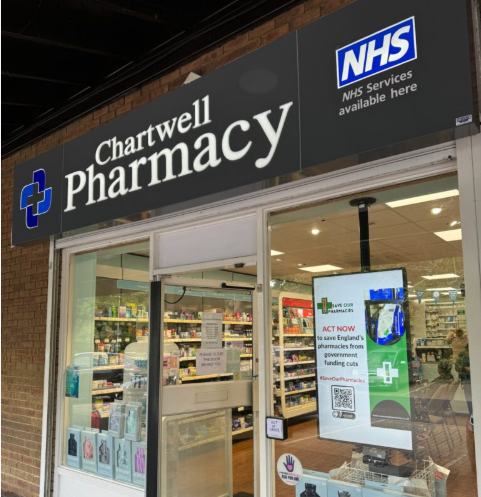
Strategically positioned LCD displays can be used at:
Store entrances — introduce health campaigns and pharmacy services.
Waiting areas — provide educational content while customers wait for prescriptions or consultations.
OTC departments — explain categories such as allergy, cold and flu, vitamins, skincare, or personal health.
Service counters — communicate operating procedures, service availability, or collection information.
Promotional areas — present approved healthcare campaigns or product education in a visually engaging format.
ZKONG’s in-store digital signage supports full-color content and continuous digital broadcasting, making them suitable for information that needs greater visual impact than an e-paper shelf label can provide.
The combination creates a useful division of roles:
ESL = precise, product-level information
Digital signage = broader educational, promotional, and service communication
This distinction is particularly relevant in healthcare retail.
The CDC’s medication-safety guidance encourages consumers to check medication labels, understand instructions, and ask a doctor or pharmacist when instructions are unclear.
Digital signage can reinforce those behaviors by displaying general health-education messages, medication-safety reminders, service information, and prompts to speak with pharmacy professionals.
It should not, however, be treated as a substitute for individualized medical advice.
The strongest case for ESLs and digital signage in pharmacies is not simply that digital screens look more modern than paper.
Their value comes from information synchronization.
Electronic shelf labels can connect centralized data with individual shelf positions. LEDs can connect staff tasks with physical locations. Inventory integration can make availability more visible. Digital signage can distribute health education and pharmacy-service information across the store.
Together, these technologies create a connected information flow:
Pharmacy System → Cloud Platform → ESL / Digital Signage → Staff and Customers
For pharmacy operators, that can mean:
fewer manually replaced shelf labels;
faster price and information updates;
better synchronization between systems and shelves;
more visible inventory exceptions; faster replenishment and product-location workflows;
clearer customer communication;
more flexible health-education content.
The objective is not to automate clinical judgment.
It is to make sure that routine store information reaches the right shelf, employee, or customer accurately, consistently, and at the right time.
For pharmacies exploring this model, ZKONG’s digital pharmacy solution combines electronic shelf labels, digital signage, cloud connectivity, and smart shelf capabilities to build a more connected physical pharmacy environment.

 Electronic Shelf Labels
  Digital Signage
  Cloud Platform
  ESL Accessory
  中文
中文 English
 日本語
日本語 français
 Deutsch