
Physical stores are no longer only places where products are displayed, compared and purchased. With connected screens, electronic shelf labels, cloud-based content management and retail data, stores can also function as coordinated media environments.
Digital in-store retail media is the use of retailer-controlled digital touchpoints inside a physical store to deliver brand, product and promotional content to shoppers. These touchpoints can extend from the store entrance and main aisle to endcaps, shelf edges and checkout areas.
The strategic shift can be summarized simply:
Store → Connected Touchpoints → Coordinated Content → Measurable Media Network
This does not mean turning every surface into an advertisement. The stronger model is a shopper-centered network in which each screen provides relevant information at the right stage of the buying journey. Entrance displays can introduce a campaign, aisle screens can guide product discovery, shelf-edge displays can support comparison, and checkout media can reinforce complementary offers.
The result is a physical store that operates not just as a sales channel, but as a connected communication channel for retailers and their brand partners.
Key takeaways:
In-store retail media connects brand communication with real shopping contexts.
Electronic shelf labels bring media and product information to the shelf edge.
Digital signage provides high-impact visual communication across store zones.
Cloud platforms allow retailers to manage campaigns across multiple devices and locations.
Retailers can create new media opportunities while improving price accuracy, product discovery and shopper experience.
Measurement, relevance and data governance determine whether a network creates sustainable value.
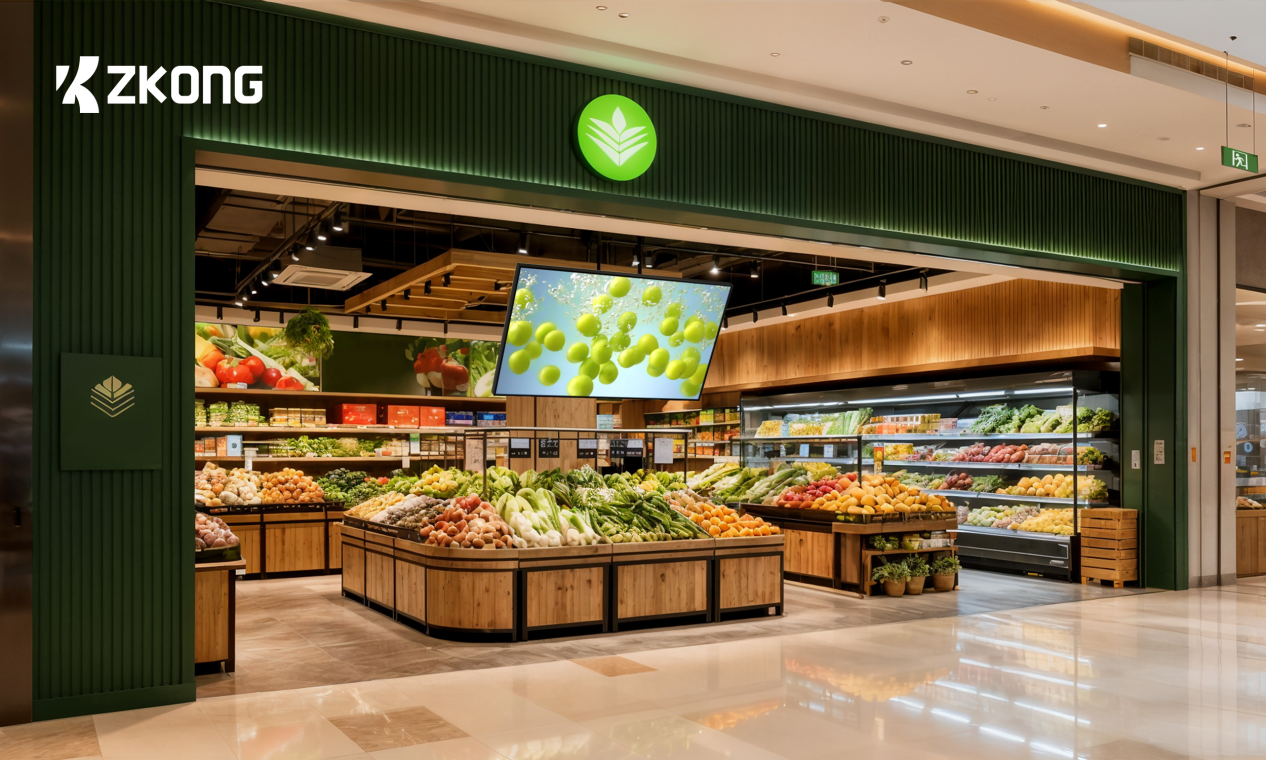
Digital in-store retail media refers to digital content delivered through retailer-controlled media inventory within a physical shopping environment. It can include paid brand campaigns, retailer promotions, product education, navigational information and personalized or context-aware content.
The IAB Digital Out of Home and In-Store Retail Media Playbook emphasizes partnerships between brands and retailers, shopper missions, in-store behavior and closed-loop measurement. This distinction is important: installing screens alone does not automatically create a retail media network.
A functional in-store media network needs:
1. Connected display infrastructure.
2. Centralized content and device management.
3. Rules for campaign placement and scheduling.
4. Integration with product, price or inventory data.
5. Defined measurement and reporting standards.
6. Clear privacy and data-governance policies.
Different store zones serve different communication purposes:
Store touchpoint | Shopper context | Recommended content |
Store entrance | Awareness and orientation | Seasonal campaigns, new arrivals, storewide promotions and brand storytelling |
Main aisle | Product and category discovery | Category education, product launches and directional content |
Endcap | Promotion and consideration | Sponsored campaigns, bundled offers and limited-time promotions |
Shelf edge | Comparison and purchase decision | Price, specifications, product benefits, QR codes and promotional messages |
Checkout | Basket completion and retention | Complementary products, loyalty programs, services and future-visit incentives |
The value of this network comes from continuity. Instead of showing unrelated messages on isolated screens, retailers can build a connected narrative across the shopper journey.
A campaign might begin with awareness at the entrance, continue with category education in the aisle, highlight a specific product at the shelf edge and conclude with a loyalty offer at checkout.
Retail media originally developed around ecommerce search results, sponsored product listings and retailer-owned digital platforms. Its expansion into physical stores is a natural next step because stores combine product availability, shopper attention and purchasing activity in the same environment.
The growth of the wider retail media market supports this transition. Nielsen reported in 2025 that U.S. retail media spending was expected to reach $60 billion in 2025 and $100 billion by 2028. In the same report, 65% of global marketers said retail media networks would play a larger role in their media mix over the following 12 months.
The wider advertising market is also directing more investment toward commerce-connected channels. According to the IAB 2025 Outlook, retail media spending was projected to grow by 15.6% in 2025, more than twice the projected 7.3% growth in overall advertising spending.
As IAB CEO David Cohen observed:
“Budgets are being focused at the points where consumers, commerce, and video converge.”
Physical stores represent exactly this type of convergence: shoppers can see a message, examine the product and make a purchase within a single environment.
Retailers have traditionally generated revenue by selling products and services. An in-store retail media network introduces an additional opportunity: retailers can offer brands access to carefully managed media placements within relevant shopping contexts.
For retailers, potential value includes:
Additional revenue from sponsored media inventory.
Stronger commercial relationships with supplier brands.
Faster execution of seasonal and local campaigns.
Better use of store traffic and physical retail assets.
More consistent communication across multiple locations.
Improved understanding of how campaigns influence category and product performance.
For brands, in-store media provides access to shoppers while they are actively browsing a relevant category. A cosmetics brand can communicate ingredients and product benefits beside the display. A food brand can promote a recipe or bundle in the corresponding aisle. An electronics brand can explain technical differences near products that shoppers are comparing.
However, monetization should not come at the expense of the shopping experience. Retailers need frequency controls, category relevance, clear pricing information and consistent visual standards. Useful media informs the shopper; excessive media creates distraction.
The shelf edge is different from a television advertisement or social media impression because it is physically connected to product availability and the immediate purchase decision.
A shopper standing in front of a shelf may be comparing:
Price and promotion.
Product size or specifications.
Ingredients or materials.
Availability and variants.
Compatibility with another product.
Ratings, instructions or usage scenarios.
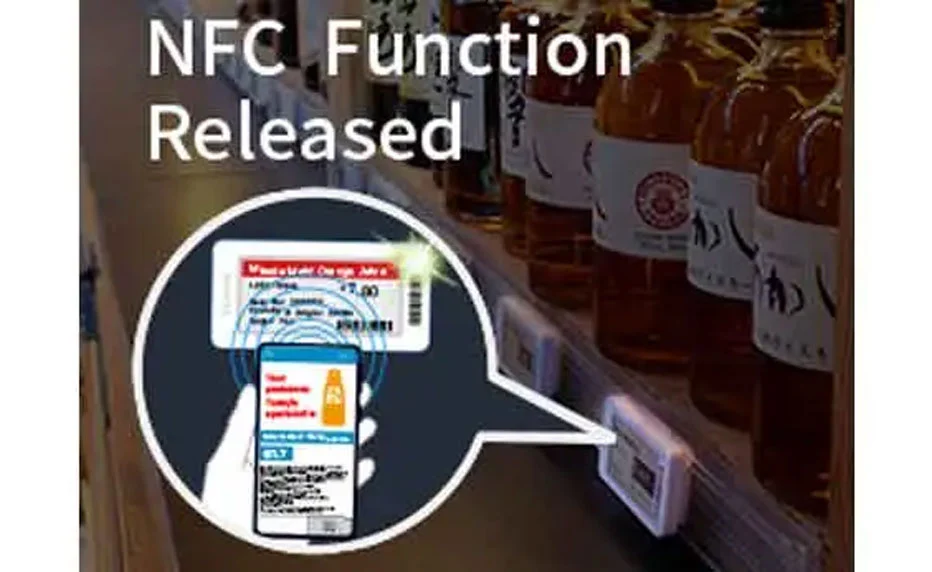
Shelf-level media can answer these questions at the moment they become relevant. It can also connect physical and digital information through QR codes, NFC-enabled interactions or links to product videos, reviews and extended specifications.
The objective is not simply to display more advertising. It is to reduce the information gap between interest and purchase.
A scalable in-store retail media network depends on several connected technology layers. Displays provide the visible media inventory, while cloud software, wireless communication and retail-system integrations coordinate what appears, where it appears and when it changes.
Retailers planning this infrastructure should evaluate it as part of a wider smart shelf technology ecosystem rather than as a collection of standalone screens.
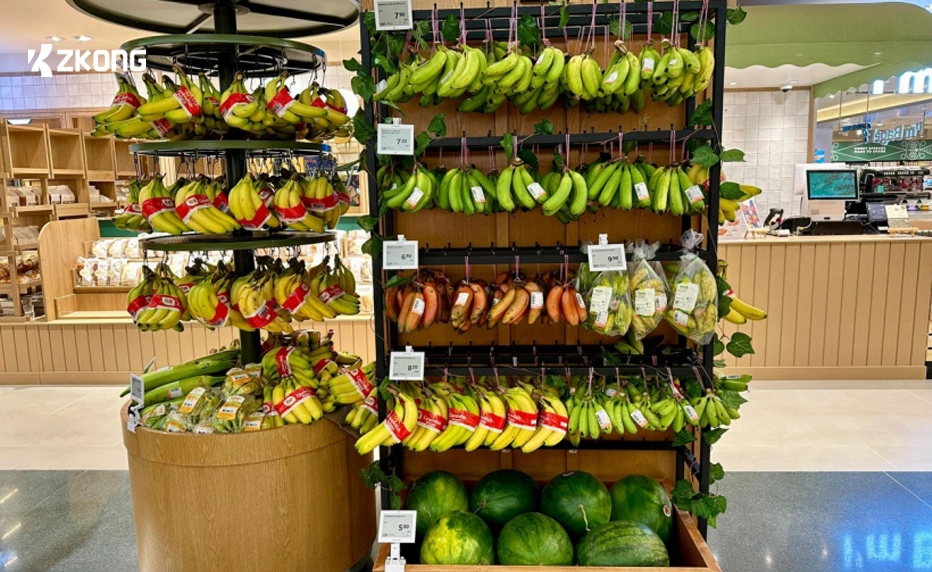
Electronic shelf labels are digital displays positioned at or near the product shelf. Their primary functions include showing prices, promotions and product information, but their role can extend to shelf-level communication.
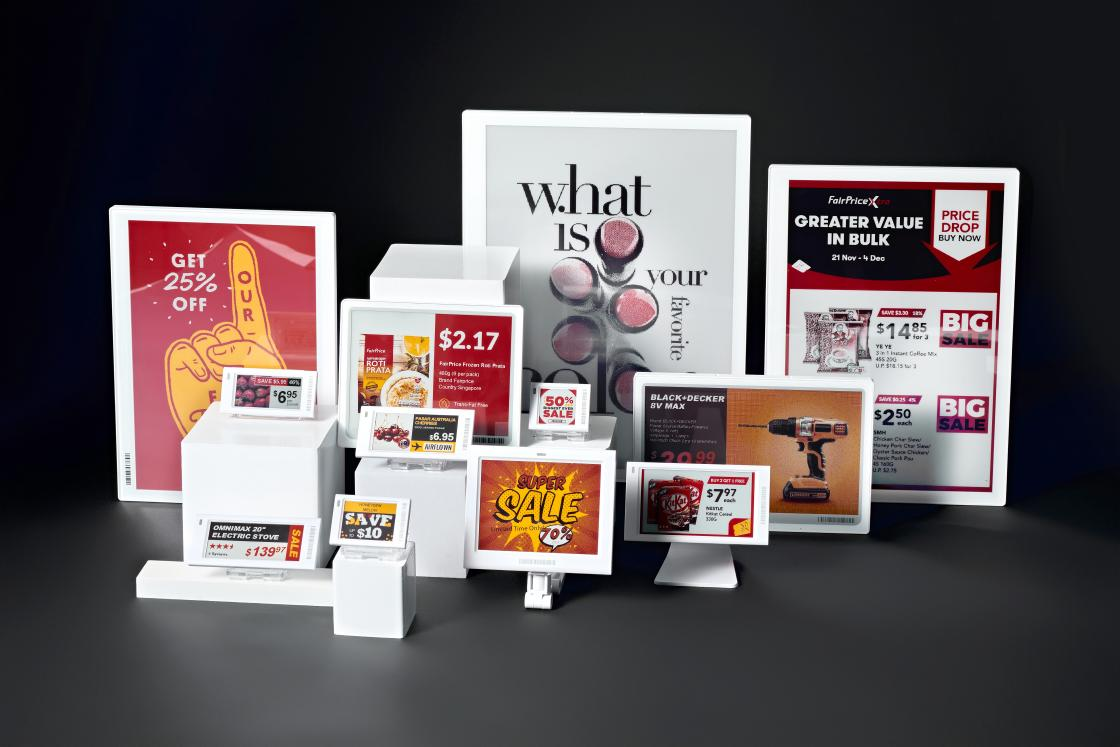
ESLs can support:
Promotion identification.
Product benefit highlights.
Loyalty-member pricing.
Stock or availability information.
Multilingual product content.
QR codes linking to videos or extended details.
Cross-selling and product-pairing prompts.
Campaign content triggered by schedule or store location.
Because electronic paper consumes power mainly when content changes, it is especially suitable for information that must remain clearly visible throughout the day without continuous power consumption.
Form factor also matters. The ZKONG Arrow Series ESL uses a bar-shaped design that can present several SKUs and prices on one screen. This format makes it suitable for endcaps, promotional islands and high-turnover displays where retailers need more coordinated shelf communication than individual labels can provide.
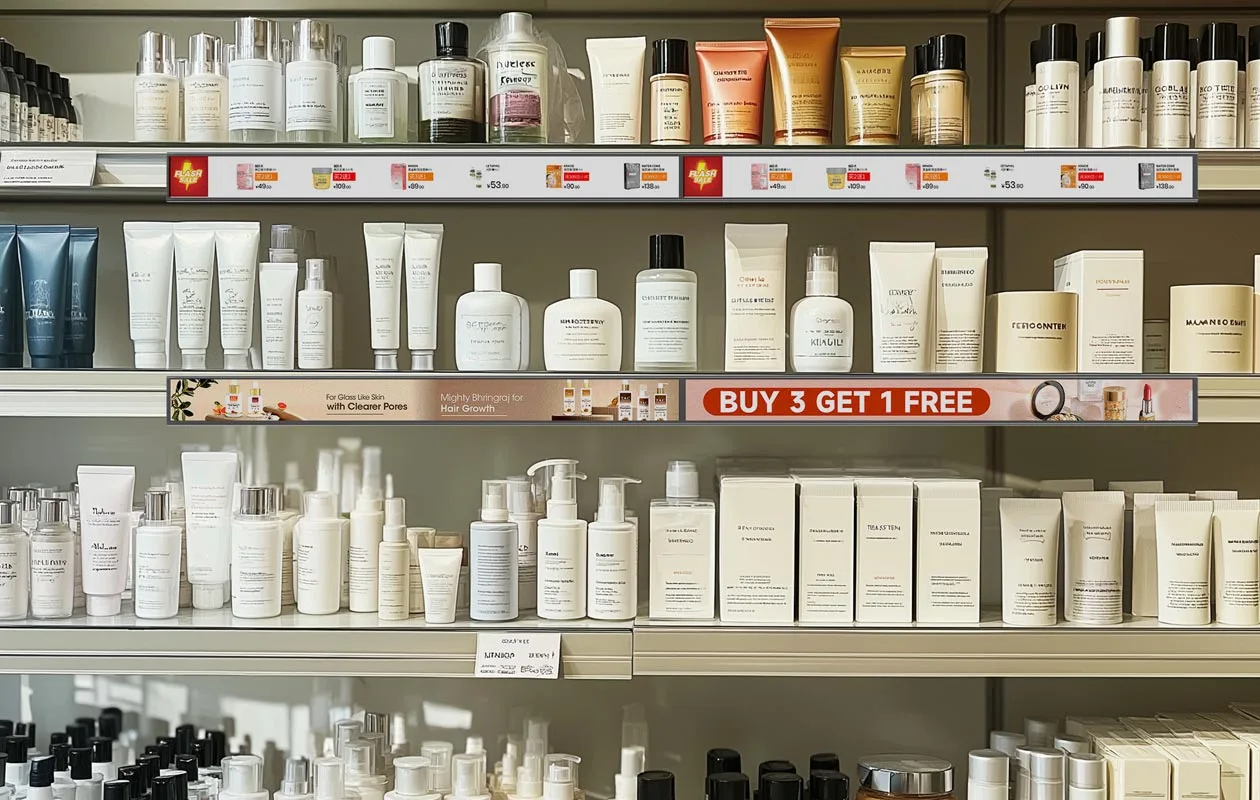
ESLs should nevertheless preserve pricing clarity. Promotional messaging must not obscure mandatory price, unit-price or product information. The most effective shelf-level media combines operational accuracy with concise, relevant content.
Digital signage supports larger, more visually expressive content than most electronic shelf labels. Retailers can use it for video, product demonstrations, brand storytelling, seasonal campaigns and category education.
Different formats support different locations:
The ZKONG Sparkle Series digital signage is suited to store entrances, aisles and promotional displays where retailers need full-color visual communication.
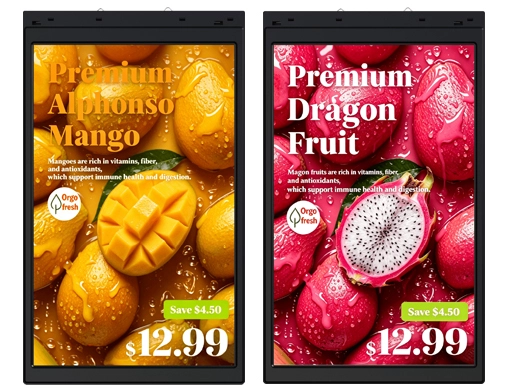
The ZKONG Legendary Series LCD brings dynamic LCD content closer to the shelf edge, supporting product videos, comparisons and high-visibility promotions near the product.
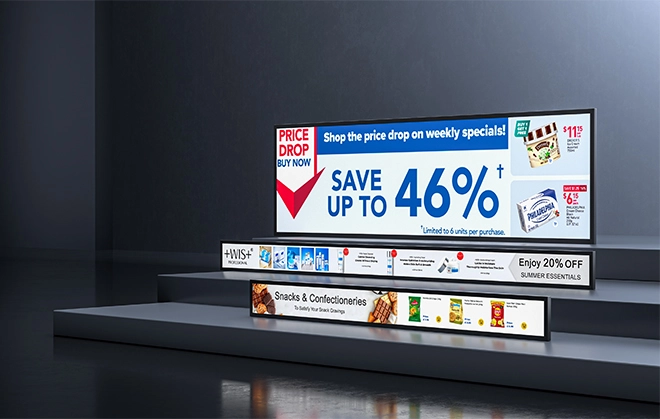
Large-format signage and shelf-edge displays should work together. A campaign displayed at the entrance can create awareness, while shelf-level content helps the shopper identify and evaluate the promoted product.
This creates a connected funnel inside the store:
Entrance awareness → Aisle discovery → Shelf consideration → Purchase
Without centralized management, a large display network can become fragmented and difficult to maintain. A retail IoT cloud platform provides the orchestration layer that connects devices, content, stores and retail data.
Cloud-based management can allow retailers to:
Build and manage reusable content templates.
Schedule campaigns by date and time.
Assign content to particular stores, zones or devices.
Localize language, currency and promotional information.
Synchronize content with price and product databases.
Monitor device and campaign status remotely.
Control user roles, publishing permissions and approval processes.
Integrate with ERP, POS, inventory and product-information systems.
This central layer is what transforms individual labels and screens into a network. Headquarters can define campaign rules and visual standards, while regional or store teams can adapt approved content to local inventory, events or shopper needs.
Successful in-store retail media is not created by a screen supplier or advertiser acting alone. It requires coordination across the full value chain:
Brand → Retailer → Store → Shopper
The brand defines the product, audience, offer and intended outcome. It may supply video, images, product benefits, educational content or promotional funding.
Content should be designed for the specific in-store environment. A shelf-edge message must be shorter and more decision-oriented than an entrance video.
The retailer controls the store environment and determines:
Which categories and locations are available.
When the campaign can run.
How often shoppers see the content.
Which products and inventory conditions qualify.
How paid media is distinguished from operational information.
What data can be used for planning and measurement.
The retailer also protects price accuracy, customer experience and brand safety.
Store-level execution connects campaign content with physical reality. A promotion should not remain active if the product is out of stock, unavailable in that location or incorrectly positioned.
Connected platforms can help local teams verify:
Device status.
Product-to-display binding.
Campaign start and end times.
Inventory availability.
Correct content placement.
Local language and regulatory requirements.
The shopper should receive a useful message, not merely an additional advertisement. Possible actions include selecting the product, comparing alternatives, scanning a QR code, joining a loyalty program or learning how to use the product.
Measurement can then consider outcomes such as product sales, category sales, campaign exposure, interaction, stock availability and incremental performance. The IAB’s 2025 framework for in-store media measurement also highlights the need for consistent, comparable and privacy-conscious measurement as the channel matures.
In-store retail media can support many physical retail formats, but the best content strategy depends on product complexity, purchase frequency, shopper dwell time and promotional intensity.
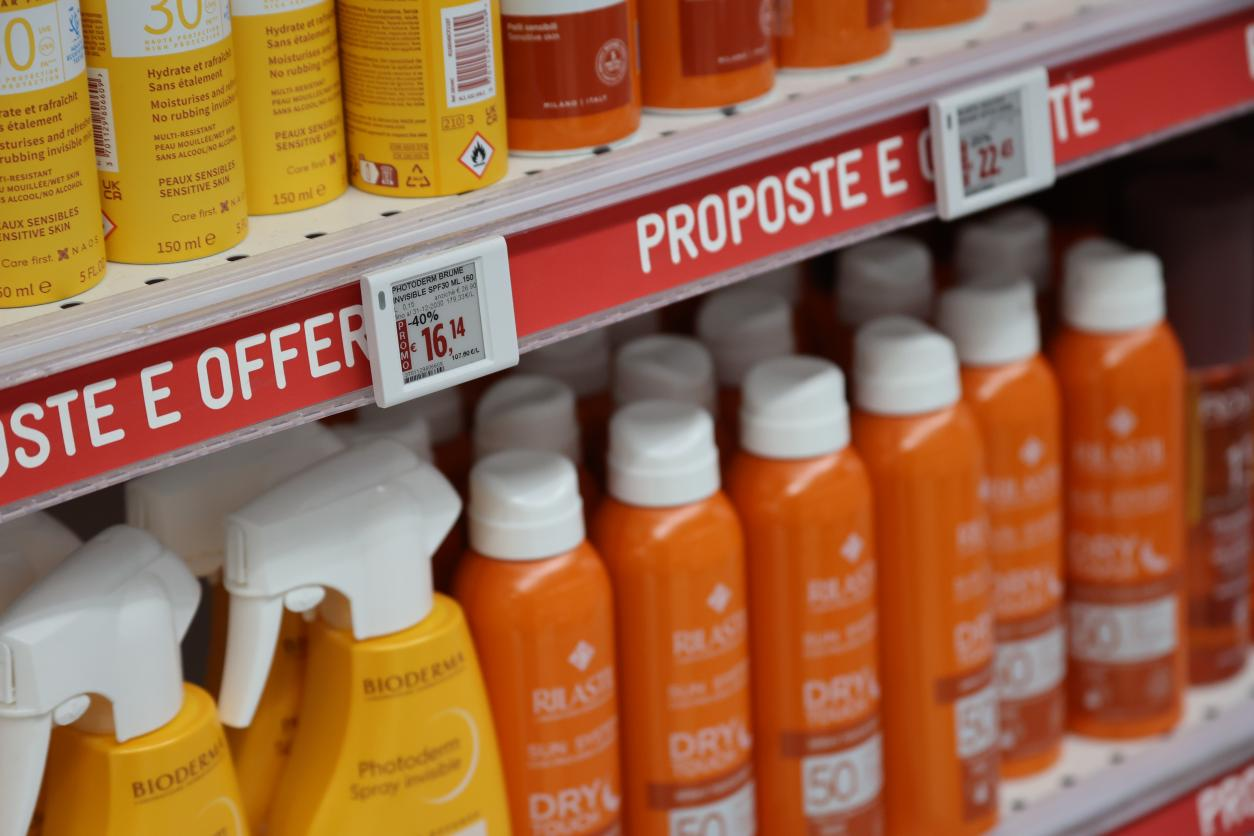
Supermarkets contain frequent price changes, large SKU counts, strong supplier participation and numerous opportunities for cross-category promotion.
A connected digital supermarket can use:
Entrance screens for weekly campaigns.
Aisle displays for category promotions.
Endcap media for sponsored products.
ESLs for price and promotion synchronization.
Shelf-edge LCD displays for recipes and product education.
Checkout screens for loyalty and complementary offers.
ZKONG’s Village Grocer ESL case demonstrates how connected electronic shelf labels can automate price updates and integrate with inventory systems across store areas. This operational foundation is essential before more advanced shelf-level media can scale reliably.
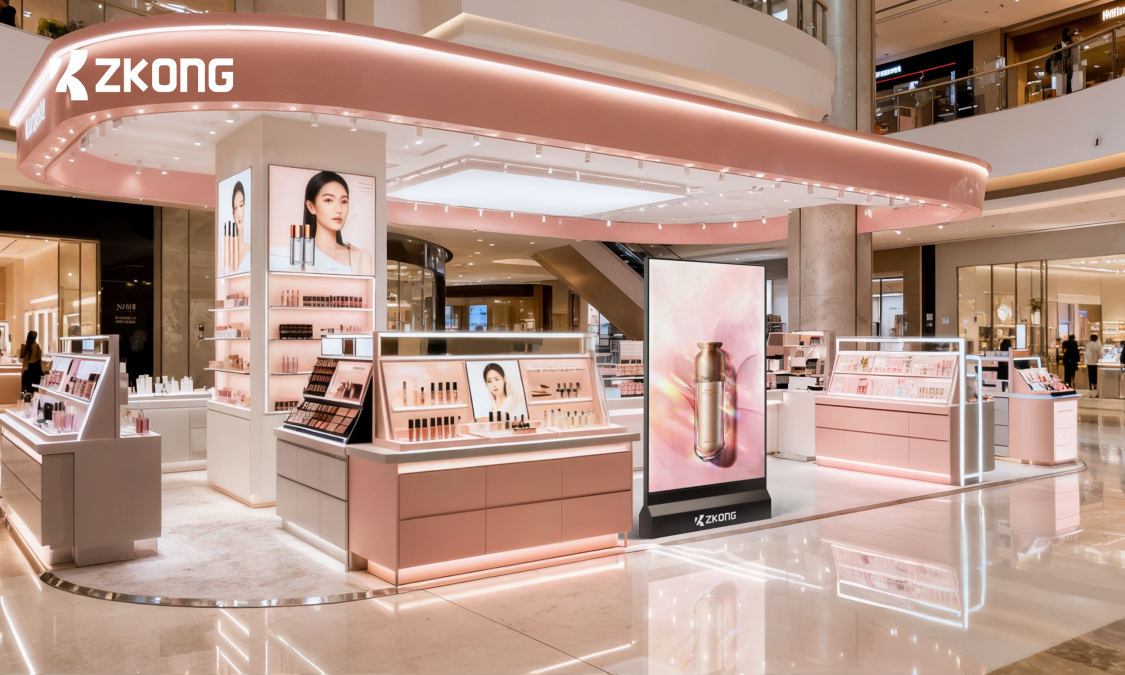
Beauty shoppers often need more information than a paper price tag can provide. Content may need to explain shade, ingredients, skin type, application method, fragrance profile or product combinations.
In-store media can support:
Product tutorials and campaign videos.
Shade and variant identification.
Ingredient and benefit communication.
New-product launches.
Cross-selling between skincare and cosmetics.
QR codes linking to extended product information.
In the Estée Lauder ESL case, electronic shelf labels were used to update prices and promotions dynamically while reducing errors and deployment costs. This creates a reliable shelf-information layer that can support richer brand storytelling.
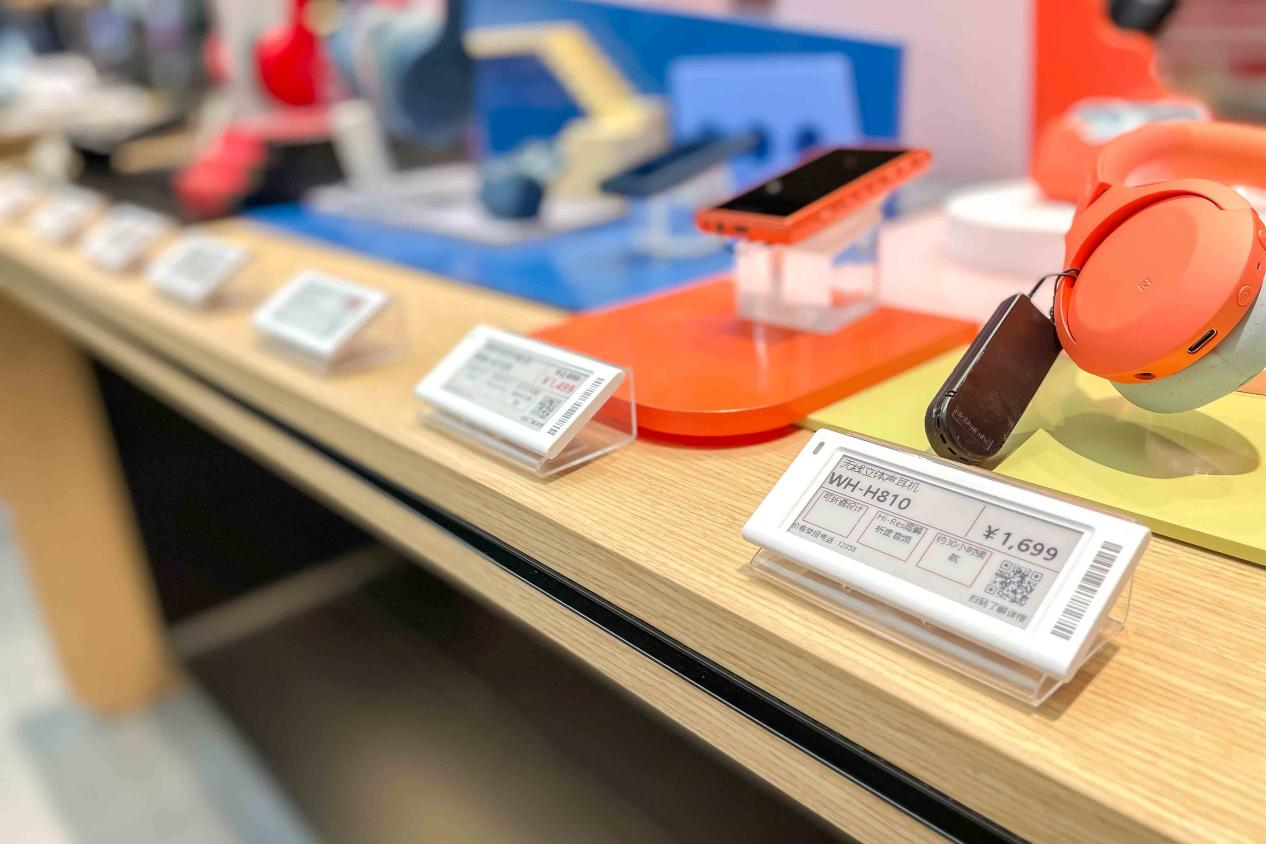
Consumer electronics involve detailed specifications, frequent product updates and high-consideration decisions. Shoppers may need to compare screen size, memory, connectivity, compatibility, energy consumption and warranty information.
A digital consumer electronics store can combine:
ESLs for accurate prices and specifications.
QR codes for manuals and product videos.
Shelf-edge LCD screens for feature comparisons.
Larger signage for launches and demonstrations.
Cloud updates for synchronized online and offline campaigns.
In this environment, in-store media is particularly valuable when it helps shoppers understand product differences rather than simply repeating brand slogans.
Convenience stores have limited space, rapid inventory turnover and short shopper visits. Media therefore needs to be immediate, local and easy to understand.
Useful applications include:
Meal and beverage bundles.
Time-of-day promotions.
Seasonal or weather-related offers.
Loyalty-program messages.
Quick product discovery.
Checkout cross-selling.
The 7-ELEVEN digital label case shows how cloud-connected ESLs can support efficient price updates across diverse convenience-store shelf environments. For this format, relevance and timing are more important than long-form creative content.
Not every store needs to become a large advertising business. However, almost every physical store can become a more connected, coordinated and measurable communication channel.
The direction of the market is clear. EMARKETER’s In-Store Retail Media 2025 report forecasts that U.S. in-store retail media advertising spending will cross $1 billion by 2029. The report also identifies grocery as an important proving ground while noting that infrastructure costs, organizational silos and fragmented execution continue to slow adoption.
The next stage will be shaped by five developments:
1. Unified physical and digital campaigns: Retail media planning will increasingly connect ecommerce, mobile applications and in-store touchpoints.
2. More intelligent content triggers: Campaigns may respond to inventory, time, location, product status and other operational conditions.
3. Standardized measurement: Retailers and brands will need comparable methods for measuring exposure, engagement and incremental sales.
4. Greater store-level localization: Central platforms will manage brand consistency while allowing approved local adaptation.
5. Shopper-centered governance: Privacy, frequency control and informational value will determine long-term acceptance.
The most successful networks will not be those with the greatest number of screens. They will be those that connect the right information, product and shopper context with the least friction.
By integrating electronic shelf labels, digital signage, cloud platforms and retail systems, physical stores can evolve from isolated sales locations into coordinated media environments—while remaining, first and foremost, useful places for people to shop.
An in-store retail media network is a system of retailer-controlled digital touchpoints inside physical stores. It can include digital signage, electronic shelf labels, shelf-edge LCD displays and checkout screens managed through a centralized platform.
Digital signage is a display technology. In-store retail media is the broader commercial and operational system that connects displays with campaign planning, retail data, placement rules, brand partnerships and performance measurement.
Electronic shelf labels can display promotional messages, product benefits, loyalty offers, QR codes and brand content alongside required price and product information. Retailers should ensure that media content does not reduce pricing clarity or compliance.
Retailers can evaluate sales lift, category performance, product availability, campaign exposure, QR-code interactions and other defined outcomes. More mature programs should also use control groups or incrementality methodologies rather than relying only on last-touch attribution.
Retailers generally need connected display hardware, a cloud-based content platform, product and price integrations, campaign-governance rules, store-level execution processes and a transparent measurement framework.


 Electronic Shelf Labels
  Digital Signage
  Cloud Platform
  ESL Accessory
  中文
中文 English
 日本語
日本語 français
 Deutsch