
E-Ink electronic shelf labels and LCD digital signage can both display prices, product information and promotions, but they are optimized for different retail tasks.
For most shelf-level pricing applications, E-Ink ESL is the better choice because it is designed for scalable, low-power price and product-data display across thousands of SKUs. LCD digital signage is better suited to visual merchandising, where retailers need full-color images, richer promotional content, animation or video.
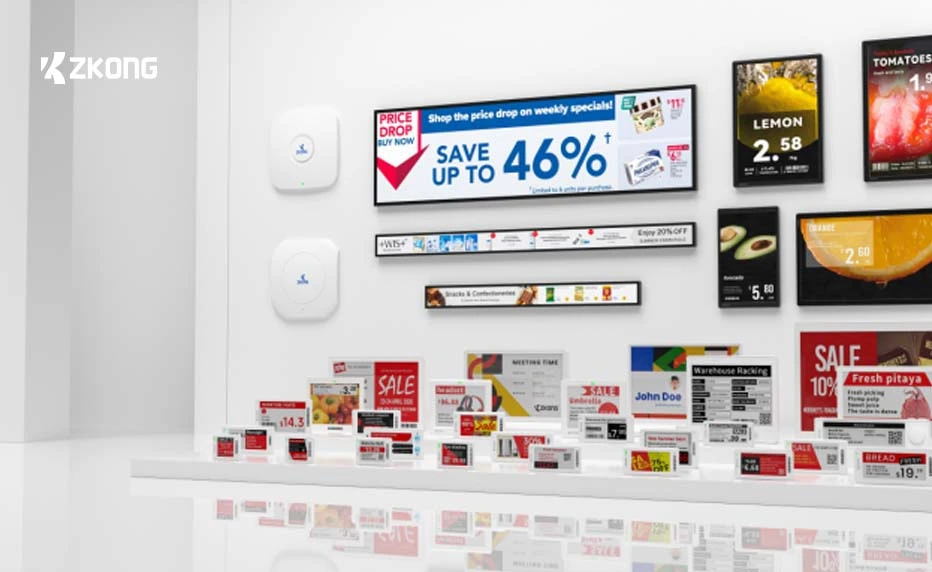
In many modern stores, however, the best answer is not E-Ink or LCD. It is a combination of both: E-Ink across high-SKU shelf areas and LCD at high-attention merchandising touchpoints.
The fundamental difference is how the two technologies create and maintain an image.
E-Ink is a reflective display technology. It uses ambient light and is optimized for static or periodically changing information. LCD is an illuminated display technology that uses liquid crystals together with a light source to generate bright, full-color visual content.
That technical difference influences almost every retail deployment decision: readability, power infrastructure, refresh speed, media capability, installation scale and ultimately the role each display should perform.
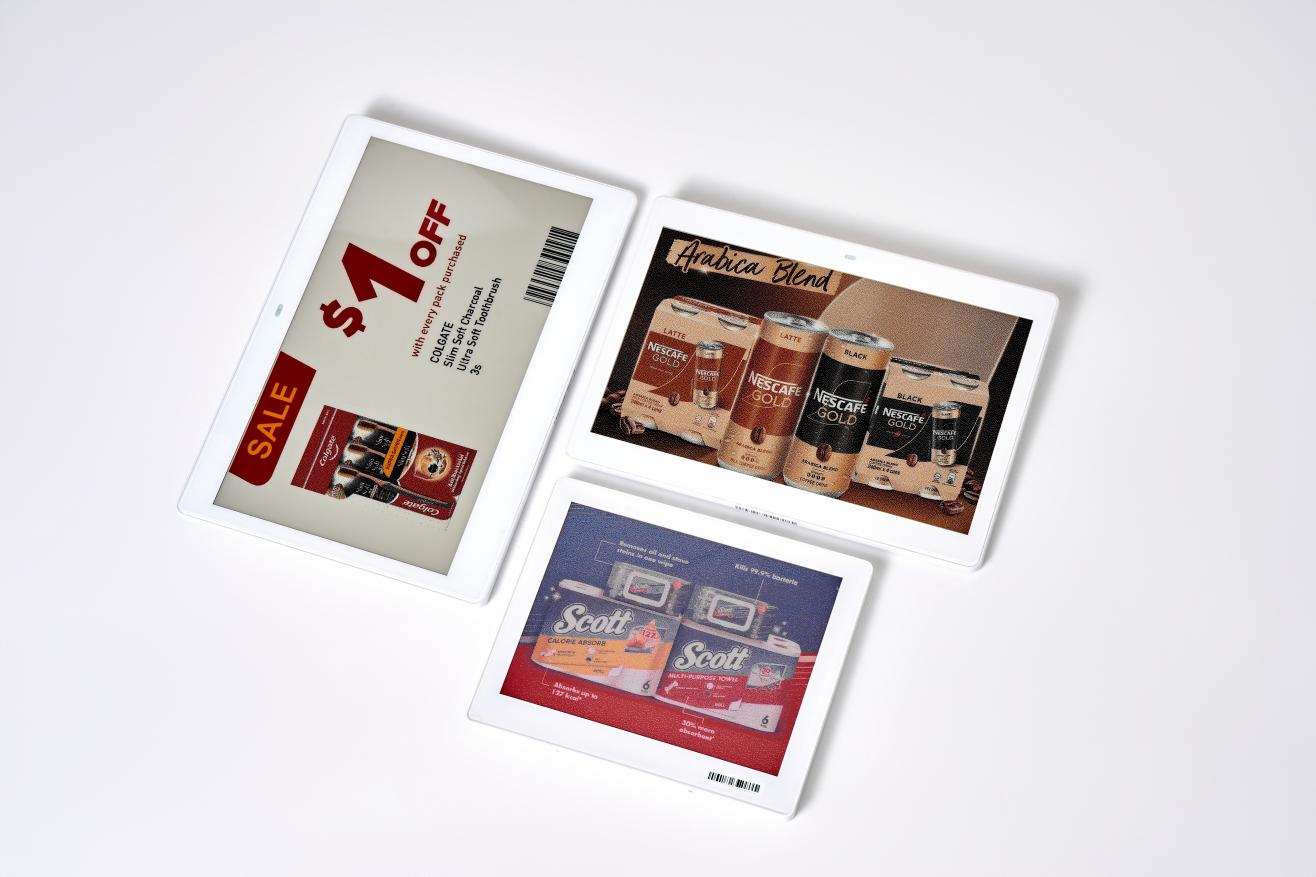
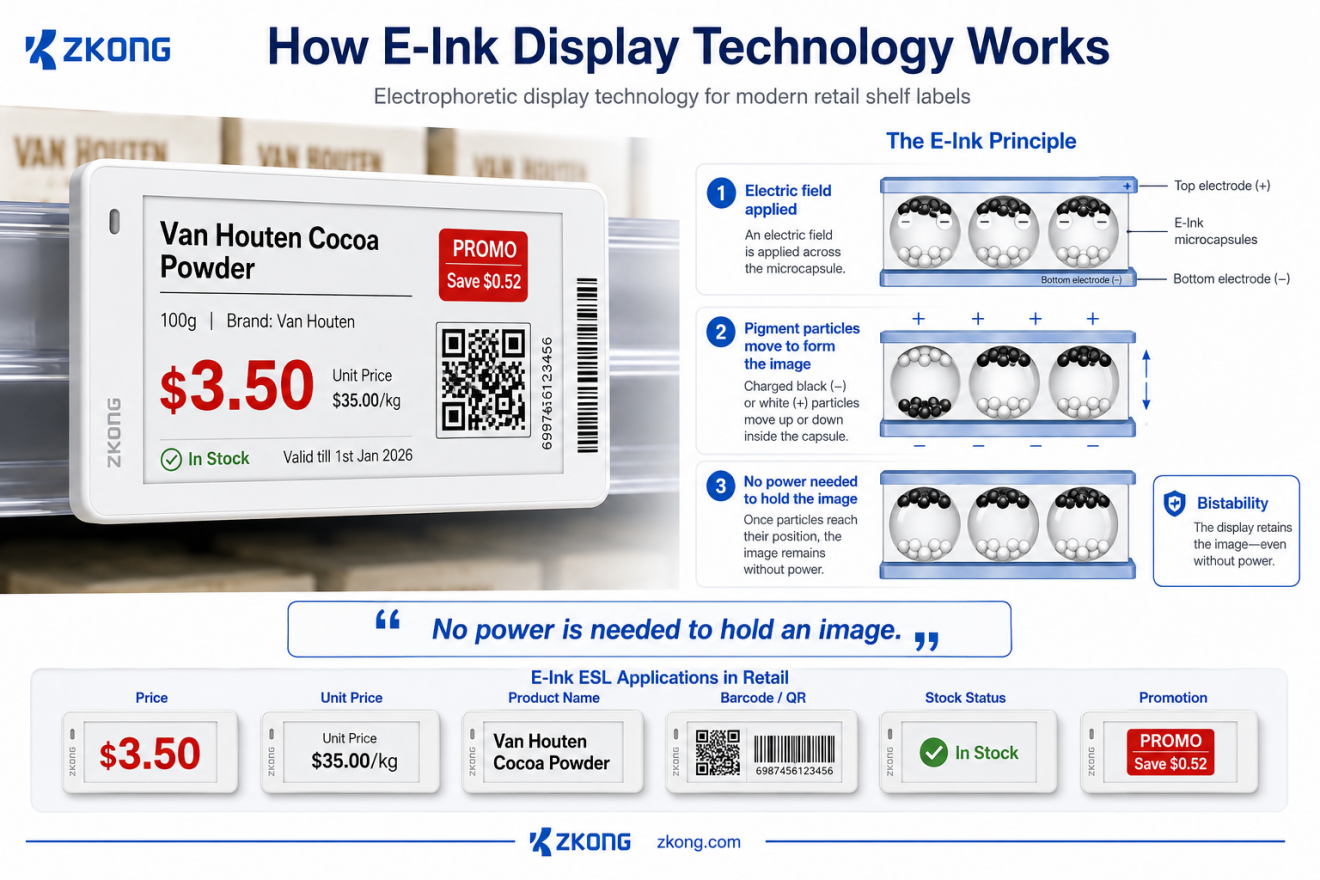
Most electronic shelf labels use electrophoretic display technology, commonly known as E-Ink or electronic paper.
Charged pigment particles are moved by an electric field to form the visible image. Once those particles reach their required position, the screen can retain the image without continuously refreshing it.
This characteristic is known as bistability.
E Ink, the developer of the underlying electronic paper technology, describes the principle succinctly: “No power is needed to hold an image.”
This makes E-Ink especially well suited to retail information that must remain visible continuously but changes only when required—for example:
price, unit price, product name, barcode, QR code, stock status, promotion information or picking indicators.
A 2025 review published in Nature Reviews Electrical Engineering also highlights the growing importance of reducing both static and dynamic power consumption in modern display systems, reinforcing why display architecture matters when thousands of screens are deployed simultaneously.
For retailers, this is why electronic shelf labels can be deployed continuously along long shelf runs without installing electrical wiring for every individual price display.
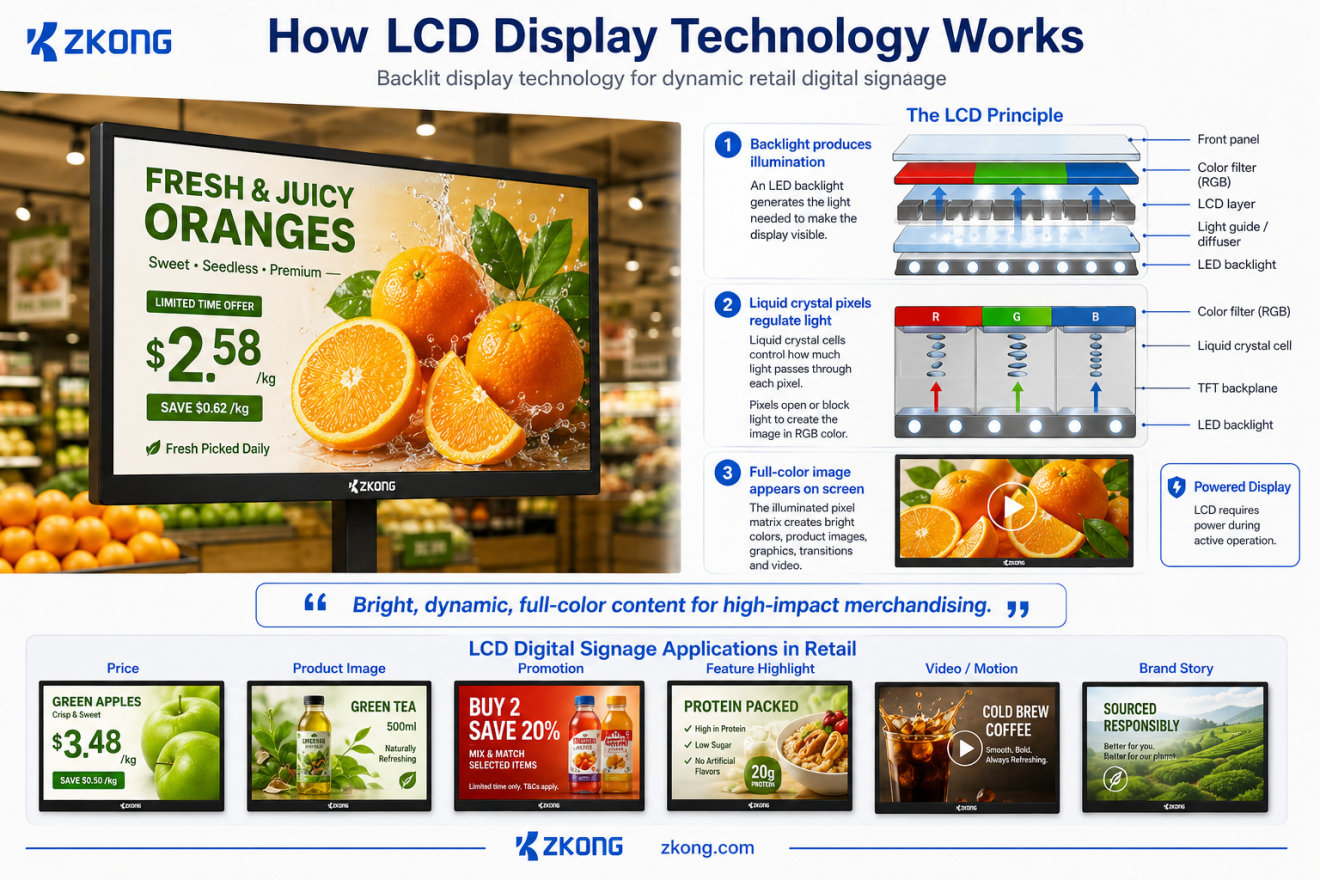
LCD—Liquid Crystal Display—takes a different approach.
Liquid crystal pixels regulate light passing through the display while a backlight produces the illumination required to make the image visible. That architecture enables LCD displays to deliver bright colors, detailed product photography, graphics, transitions and video.
The result is far greater creative flexibility.
Instead of simply communicating “What does this product cost?”, an LCD display can help answer questions such as:
What does the product look like in use? What makes it different? What promotion is running today? Which shade, style or feature should the shopper choose?
The trade-off is power.
Unlike a bistable E-Ink display, an active LCD display needs power to operate its backlight and display electronics. U.S. Department of Energy guidance, updated in December 2024, therefore specifically emphasizes energy-management modes for displays and signage displays, including low-power standby operation and switching displays off when they are not needed.
For shelf-edge retail applications, LCD is therefore usually treated as powered digital signage, rather than a direct one-for-one replacement for every paper price label.
The shelf edge serves two very different business functions.
The first is transactional information:
Product → Price → Availability → Purchase
The second is merchandising communication:
Product → Attention → Information → Desire → Purchase
E-Ink is optimized primarily for the first workflow. LCD strengthens the second.
This distinction is more useful than asking which screen technology is simply “better.”
For grocery retailers managing tens of thousands of prices, reliability, deployment density and low power matter more than video playback. For a cosmetics retailer launching a new skincare collection, however, accurate prices alone may not create enough visual impact.
The right display technology therefore depends on the job the shelf is expected to perform.
Comparison Factor | Best Retail Role | ||
Primary purpose | Pricing and product information | Visual merchandising and promotional communication | Different but complementary |
Display method | Reflective electronic paper | Backlit liquid-crystal display | — |
Typical content | Price, unit price, product name, barcode, QR code, stock data, promotional text | Price, text, images, product photography, graphics, promotions and video | — |
Color capability | Limited or multi-color electronic paper depending on model | Full color | LCD for visual content |
Video / animation | Generally not designed for video | Supported | LCD |
Power requirement | Extremely low; power mainly required during updates | Requires power during active operation | E-Ink for high-density deployment |
Typical power infrastructure | Battery-powered ESL | Wired/DC-powered signage | — |
Readability | Paper-like, reflective appearance | Bright, illuminated display | Depends on environment |
Best deployment scale | Hundreds or thousands of shelf positions | Selected strategic touchpoints | E-Ink for SKU scale |
Dynamic pricing | Excellent | Technically possible but less efficient at mass SKU scale | E-Ink |
Visual merchandising | Limited | Excellent | LCD |
Typical retail locations | Standard shelves, grocery aisles, pharmacy shelves, convenience stores | Endcaps, promotional zones, cosmetics counters, fashion displays, electronics displays | — |
Content management focus | Product and pricing data | Marketing and merchandising assets | — |
The key takeaway is straightforward:
Choose E-Ink when the display’s primary job is to communicate accurate product and pricing data at scale. Choose LCD when the display’s primary job is to attract attention and communicate richer visual content.
Readability is not simply a question of resolution.
Retailers should ask what type of information shoppers need to see, from what distance, under what lighting conditions and for how long.
E-Ink behaves more like printed paper than a conventional illuminated screen.
Because the display reflects ambient light instead of depending on a backlight, price information remains visually stable while shoppers move along the shelf. This makes it particularly effective for information-dense environments such as supermarkets, pharmacies and convenience stores.
A shopper examining a grocery shelf does not need a video beside every SKU.
They need to quickly identify:
product → price → promotion → unit information
That is precisely the information hierarchy for which E-Ink ESLs are designed.
The technology also helps retailers maintain a cleaner and more consistent shelf appearance because the same digital templates can be synchronized across stores.
This is particularly important in a digital supermarket, where thousands of shelf positions may need to reflect centrally controlled prices and product data.
LCD becomes more valuable when the business objective changes from displaying information to influencing attention.
Full-color imagery makes it possible to display lifestyle photography, product benefits, ingredient explanations, comparison graphics, campaign creative and video.
That makes LCD digital signage particularly relevant to categories where products need to be explained or emotionally presented.
Consider Beauty & Cosmetics Retail.
A price label can tell a shopper that a foundation costs $39.99. An LCD display can simultaneously communicate shade range, skin type, texture, application method and campaign imagery.
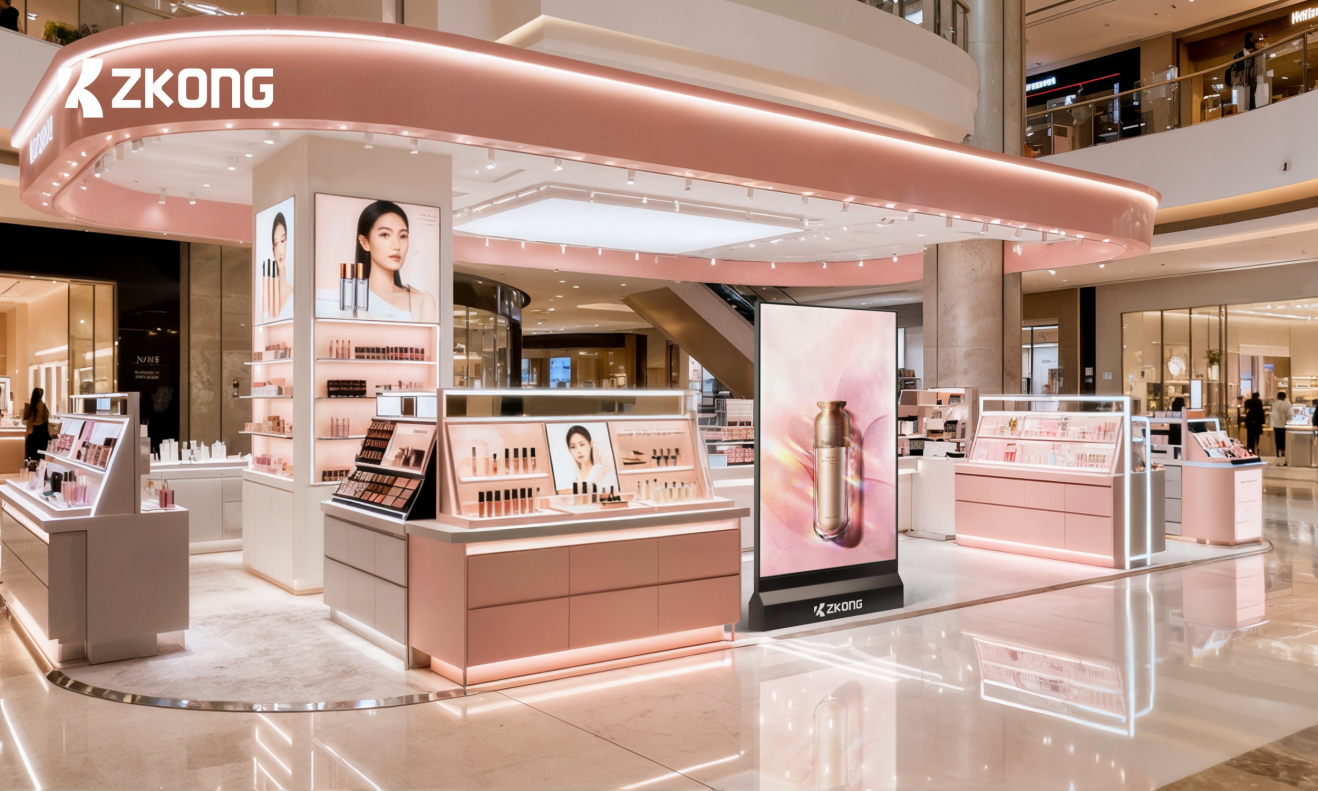
In Fashion & Department Stores, the difference is similar. E-Ink can handle product pricing and promotional information, while LCD can show seasonal collections, styling combinations, campaign visuals or short-form brand content.

The technologies are therefore addressing different stages of the purchase decision.
E-Ink communicates facts efficiently. LCD adds visual persuasion.
Power architecture becomes critical as the number of digital shelf displays increases.
The difference between powering ten displays and powering 20,000 shelf positions fundamentally changes deployment economics.
E-Ink’s bistable architecture means that energy is primarily required when the image changes.
Once a new price or product template has been rendered, the display can remain visible without continuously powering the pixels.
Large-format e-paper provides an illustrative example of the underlying energy difference. In its 2024 Corporate Sustainability Report, E Ink compared a 32-inch Spectra 6 e-paper display updated three times per day with a professional commercial display operating for 18 hours. The report calculated daily electricity consumption of 0.0281 kWh for the e-paper display versus 1.296 kWh for the commercial screen under the stated test assumptions.
This is not a direct energy benchmark between a small ESL and a shelf-edge LCD product—the screen sizes and operating conditions of individual retail products vary—but it illustrates why static electronic-paper applications can operate with radically different power requirements from continuously illuminated displays.
That difference matters when digital price displays are repeated across every aisle and every SKU.
LCD’s strength—bright, illuminated, continuously changing visual content—is also why its power model is different.
When an LCD is actively displaying content, the display electronics and illumination system require power. Video playback, high brightness and continuous promotional content further reinforce the need for a stable power infrastructure.
This does not make LCD inefficient for its intended purpose.
It simply means retailers should deploy it where the additional visual capability produces enough merchandising value to justify the additional infrastructure.
The relevant question is therefore not:
“Which technology consumes less power?”
E-Ink clearly has the structural advantage for static information.
The more useful question is:
“Where is continuous illumination valuable enough to justify it?”
Power architecture directly affects where each technology can scale.
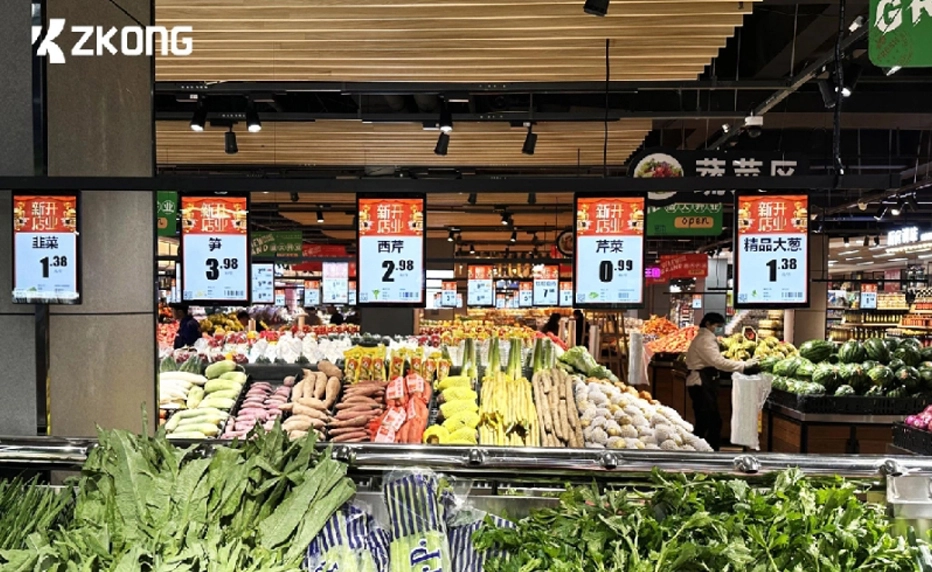
Battery-powered ESLs can be attached across long shelf runs, refrigerated areas and high-density SKU environments without routing electrical wiring to every label.
LCD requires more deliberate planning around power rails, wiring, fixtures and display placement.
That makes a hybrid deployment economically logical.
A supermarket might deploy E-Ink across 20,000 or 50,000 individual product positions, while installing LCD only at high-value category entrances, fresh-food counters, endcaps and promotional zones.
The screen count becomes lower, but each LCD screen has a clearer merchandising purpose.
Both E-Ink and LCD can display changing prices.
That does not mean they deliver the same business value.
The important difference is the type and frequency of content each technology is designed to manage.
The core strength of an ESL is structured, SKU-level information.
An ESL can dynamically display:
prices and markdowns, unit pricing, product descriptions, barcodes, QR codes, stock information, membership prices, promotional indicators and operational information.
When integrated with POS, ERP or other retail systems, this allows pricing information to flow from central systems directly to the shelf.
The workflow becomes:
Pricing System → Cloud Platform → Store Network → ESL → Shopper
This architecture is especially important for dynamic pricing because price changes can be executed across large numbers of SKUs without manually replacing paper labels.
E-Ink is therefore not merely a different type of screen. It functions as part of the retail pricing infrastructure.
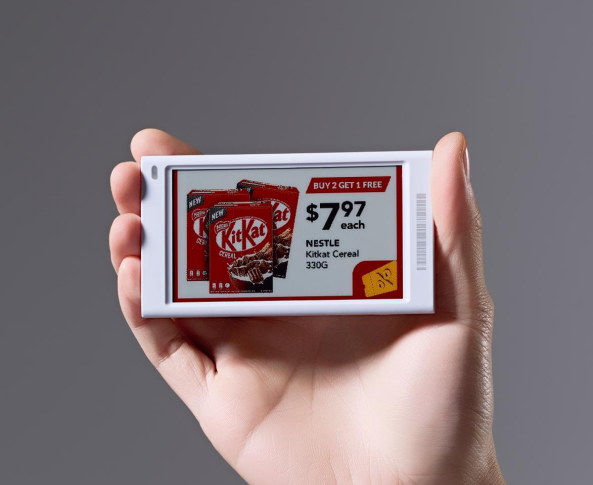
LCD can also display a product price, but stopping at the price wastes much of the technology’s advantage.
Its real value appears when pricing information is combined with richer creative assets.
A shelf-edge LCD might display a price alongside product photography, a limited-time campaign, feature explanations, a product comparison, recipe inspiration, a QR code or video content.
ZKONG’s current digital signage portfolio, for example, supports full-color content including text, images and video, allowing the display layer to extend beyond basic shelf labeling into digital merchandising.
The workflow becomes:
Product Data + Campaign Content → Content Platform → LCD → Shopper Engagement
That is why LCD should primarily be evaluated as a visual merchandising medium, not simply as a more colorful electronic price tag.
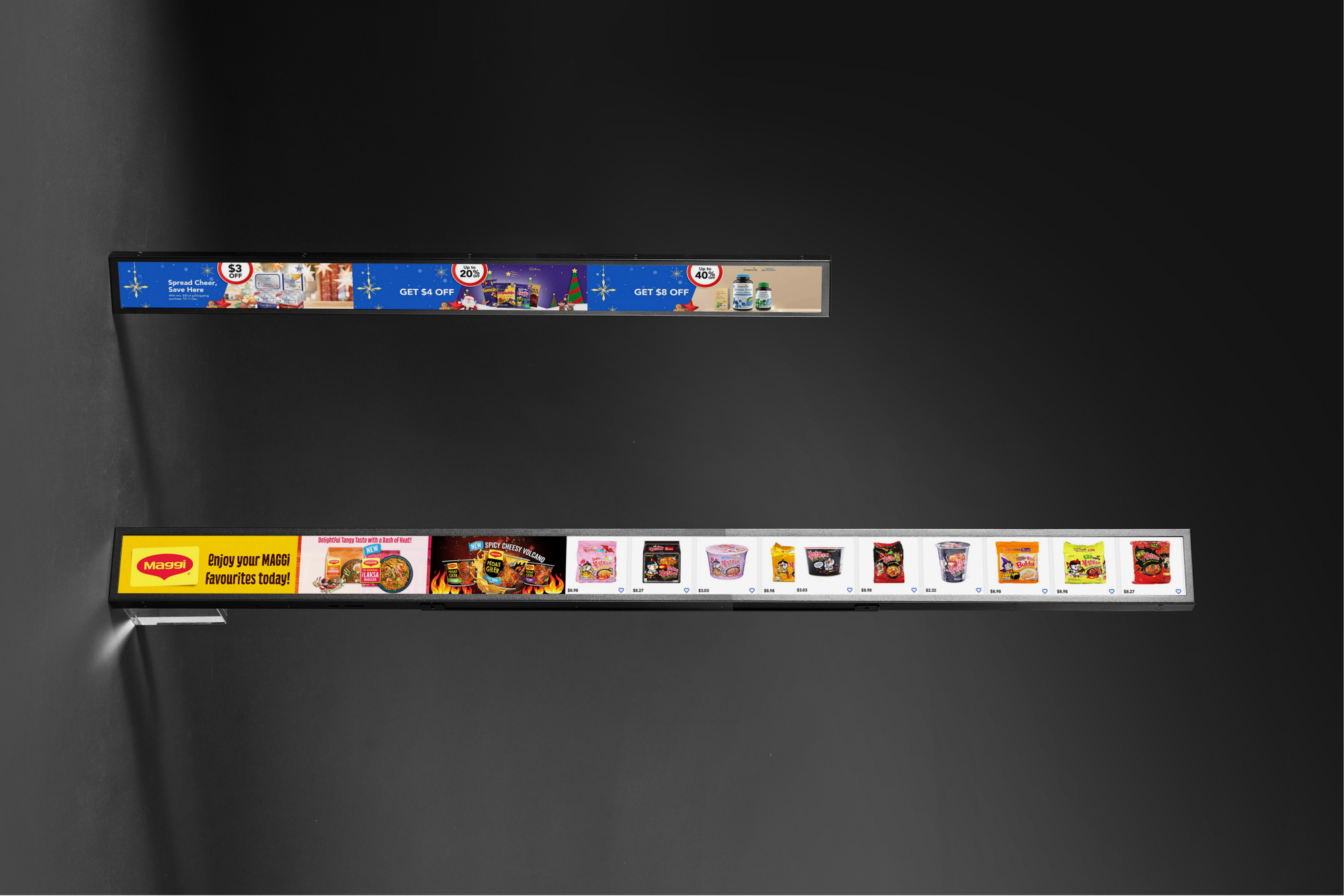
Dynamic content creates value when additional visual communication can influence the purchase decision.
This is especially relevant in product categories with high margins, frequent campaigns, strong brand differentiation or greater information requirements.
Beauty and cosmetics are a good example because shoppers may need to understand benefits, application methods, ingredients, skin type or shade options before purchasing.
Fashion offers similar opportunities around styling, seasonal collections, cross-selling and brand storytelling.
Consumer electronics can use LCD displays to explain technical specifications or visually compare features.
In contrast, placing video beside every commodity SKU in a grocery aisle may introduce unnecessary hardware, power and content-management complexity.
Retail media growth also strengthens the business case for carefully positioned digital displays. IAB Europe’s 2025 Attitudes to Retail Media study surveyed more than 180 industry professionals across 31 markets and noted growing interest in in-store digital screens as retailers develop more omnichannel media strategies.
In 2025, European Retail Media spending grew 16.7% to €13.3 billion, according to IAB Europe’s AdEx Benchmark 2025 report released in July 2026.
The broader implication is important: the physical store is increasingly becoming both a commerce environment and a media environment.
As IAB Europe’s Marie-Clare Puffett put it in 2025:
“Retail Media is no longer an emerging trend, but a strategic priority.”
That does not mean every shelf needs an LCD screen.
It means retailers should identify the locations where richer digital content can create measurable merchandising value—and deploy LCD there.
For large-scale SKU coverage, E-Ink ESL is generally the more practical technology.
Consider a supermarket with 30,000 SKUs.
If every shelf position requires accurate prices, unit pricing and promotion information, the retailer needs a display architecture that can operate at very high density without installing thousands of new electrical connections.
That requirement favors battery-powered E-Ink.
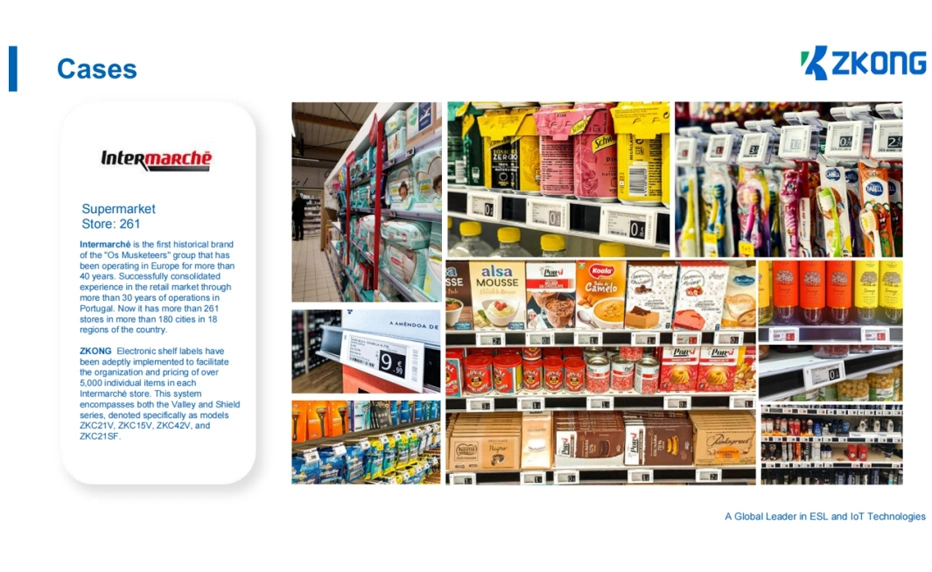
A real-world example can be seen in ZKONG’s ICA Supermarket deployment. More than 1.2 million ESL tags were deployed across stores, with an average of 12,000+ digitally labeled SKUs per store. The deployment also included 10.1-inch LCD signage, demonstrating how different display technologies can coexist within the same digital-store architecture.
The scale principle is therefore:
High SKU density → E-Ink
High attention value → LCD
Retailers should not measure LCD deployment success by how many screens they can install. They should measure whether each screen improves merchandising communication at a meaningful customer touchpoint.
Yes. In many retail environments, retailers should use E-Ink ESL and LCD digital signage together rather than choose only one technology.
The two displays can form different layers of the same smart retail infrastructure.
E-Ink creates a scalable digital information layer across the shelf. LCD creates a visual merchandising layer at selected points of shopper attention.
Standard shelf areas should prioritize information accuracy, consistency and scalability.
E-Ink is therefore ideal for grocery aisles, pharmacy shelves, convenience stores, hardware stores and other environments with large SKU counts.
It becomes the persistent digital interface between product data and the physical shelf.
Centralized updates allow retailers to synchronize pricing and promotional information without turning every shelf position into a powered multimedia display.
LCD should be concentrated where visual communication has a strong commercial purpose.
That can include category entrances, promotional islands, endcaps, premium product bays, beauty counters, fashion displays and high-consideration product areas.
In these locations, LCD can transform the display from a digital price holder into a merchandising surface.
The strategy is not more screens everywhere.
It is richer screens where attention is valuable.
The biggest opportunity appears when ESL and LCD are not managed as isolated hardware systems.
Pricing data, product information, inventory information and marketing content should flow through a connected retail technology stack.
A simplified architecture might look like:
ERP / POS / Product Database
↓
Cloud Retail Platform
↓
Pricing & Product Data → E-Ink ESL
Campaign & Visual Content → LCD Digital Signage
↓
Physical Shelf and Shopper
This approach allows the retailer to separate display roles without separating the underlying data infrastructure.
The ICA Supermarket deployment illustrates this model: its solution integrates ESL and LCD signage through a unified cloud platform, allowing structured pricing information and richer promotional communication to operate within the same store environment.
For retailers building a modern smart store, this is ultimately more important than choosing one screen specification over another.
The objective is to build an infrastructure in which the right content reaches the right display at the right customer touchpoint.
Choose E-Ink ESL if your primary goal is retail shelf pricing. Choose LCD digital signage if your primary goal is visual merchandising. Use both if you need scalable pricing automation and richer in-store customer communication.
For retailers managing thousands of SKUs, E-Ink should normally form the foundation of the digital shelf because it provides low-power, scalable and continuously visible price and product information.
LCD should then be added selectively where full-color imagery, promotional creative, detailed product education or video can influence customer attention and purchase decisions.
In practical terms:
E-Ink ESL = Price Display + Product Data + Store Operations
LCD Digital Signage = Visual Merchandising + Promotion + Customer Engagement
The technologies are therefore not competing for exactly the same role.
A modern retail store can use E-Ink to digitize every shelf that needs accurate information, while using LCD to enhance the touchpoints where richer content can create additional value.
That combination creates a more practical path from digital shelf pricing to a fully connected smart retail environment.

 Electronic Shelf Labels
  Digital Signage
  Cloud Platform
  ESL Accessory
  中文
中文 English
 日本語
日本語 français
 Deutsch