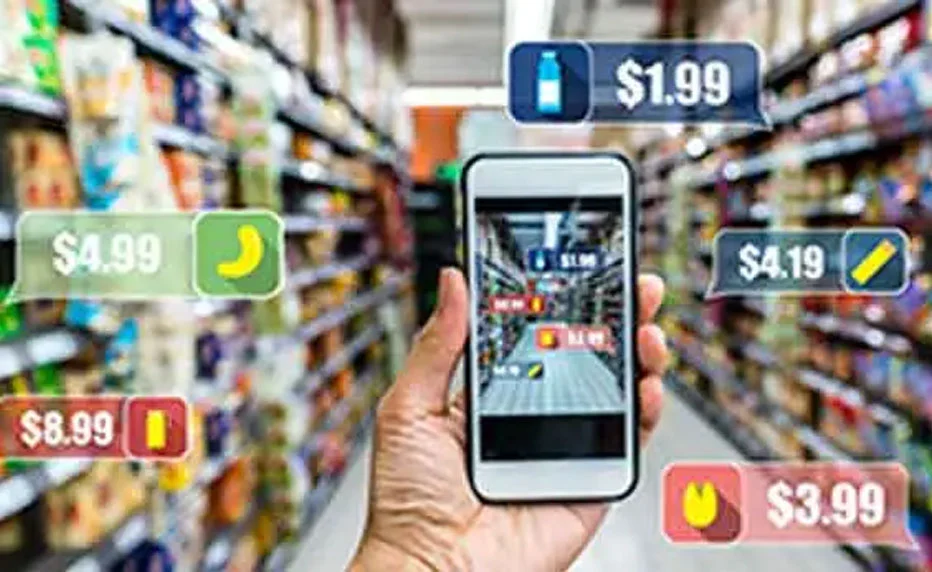

In the fresh retail industry, time is money, and efficiency determines success or failure. From the hustle and bustle of morning markets to the busyness of fresh food sections in supermarkets, every circulation of fresh fruits, vegetables, meat, and aquatic products implies a game between costs and profits. In this special track, electronic price labels, as "smart labels", are quietly rewriting industry rules and becoming a winning weapon in the hands of fresh retailers.
Fresh retail includes vegetables, fruits, fresh meat, etc. These products have a short shelf life and are affected by various factors such as market supply and demand, seasonal changes, and weather conditions. Their purchase prices may vary every day, and their selling prices may also change accordingly. If paper price labels are used, store staff need to manually modify the prices and replace the labels one by one every day, which not only consumes time and energy but also generates a large number of discarded paper price labels.

Moreover, many fresh retail stores will carry out promotions based on the proximity of the expiration date. For example, some expired fruits may deteriorate in a couple of days, and stores need to adjust prices for promotions at any time. By using electronic price labels, e-ink screens, and cloud price labels, which are connected to the platform through base stations, multiple electronic price labels can be modified with one click in real-time, and automatic price changes at preset times can also be realized. This reduces the loss rate of fresh products and lowers the workload and error rate of manual price label replacement.
Compared with ordinary retail product price labels, which only need to display the product name and price, customers are often concerned about the type, unit price, and origin of many fresh fruits and vegetables. Electronic price labels can display more comprehensive information and even place QR codes for customers to scan and learn more details about the products.
For fresh retail operators, electronic price labels are connected to the background management system, enabling real-time synchronization of inventory information. When the inventory quantity is lower than the set value, the system will automatically remind for replenishment. This not only avoids out-of-stock situations but also improves inventory turnover rate, reduces inventory costs, and enhances inventory management levels.
One of the core advantages of electronic price labels lies in their strong price management capabilities. Through the base station connected to the platform, merchants can modify the prices of multiple electronic price labels with one click in real-time. Whether it is necessary to adjust the selling price due to changes in purchase costs or to reduce prices for promotional activities, it can be completed in an instant, greatly improving the efficiency of price adjustment.
Furthermore, digital price labels also support automatic price changes at preset times. Merchants can set the discount time and range for expired products in advance, and the system will automatically modify the label information at the specified time. This intelligent price management method makes the promotion of fresh products more timely and accurate, effectively reducing the loss rate of products. At the same time, it reduces the workload of manual price label replacement and possible errors, allowing store staff to focus more energy on other important tasks.

The in-depth connection between electronic price labels and the background management system has brought revolutionary changes to the inventory management of fresh retail. By synchronizing inventory information in real-time, merchants can keep track of the quantity of goods in stock at any time. When the inventory is below the set value, the system will automatically send a replenishment reminder, avoiding stockouts and ensuring that customers' shopping needs are met.
In the highly competitive fresh retail market, electronic price labels are emerging as "smart labels", becoming an important tool for fresh retailers to enhance their competitiveness and achieve sustainable development. They not only solve the long-standing pain points and problems in the industry but also point out the direction for the future development of fresh retail.
 Electronic Shelf Labels
 Digital Signage
 Cloud Platform
 ESL Accessory
 中文
中文 English
 日本語
日本語 français
 Deutsch