
Starting a grocery store has always been one of the most resilient retail business opportunities. Consumers need daily essentials regardless of economic conditions, making grocery retail a cornerstone of local commerce.
However, the grocery industry is changing rapidly. Today's shoppers expect more than stocked shelves and competitive pricing. They want convenience, accurate product information, personalized promotions, fast service, and seamless shopping experiences.
This shift has given rise to what many industry experts call Modern Retail or Smart Retail—a technology-driven approach that combines digital infrastructure, automation, data analytics, and customer-centric experiences.
According to the Food Industry Association (FMI), U.S. grocery sales continue to exceed $1 trillion annually, while retailers are increasingly investing in digital transformation technologies to improve efficiency and customer satisfaction.
For entrepreneurs planning to enter the grocery industry, success in 2026 requires more than opening a store—it requires building a smart retail ecosystem from day one.
This guide explains how to start a modern grocery store and how technologies such as Electronic Shelf Labels (ESLs), Digital Signage, Delivery Robots, and Smart Retail Platforms can help create a future-ready business.
Modern retail refers to the integration of digital technologies into traditional retail operations to improve efficiency, customer engagement, and business performance.
Unlike traditional stores that rely heavily on manual processes, smart retail stores use connected systems to manage:
Pricing
Inventory
Promotions
Store operations
Customer experiences
A modern grocery store typically includes:
Real-time inventory management
Electronic Shelf Labels
Digital signage networks
Cloud-based retail platforms
Mobile shopping experiences
Automated fulfillment systems
AI-powered analytics
According to Deloitte's Future of Retail research:
“Retailers are increasingly investing in digital technologies that connect physical and digital experiences into one seamless customer journey.”
Before selecting technologies, determine what type of grocery store you plan to operate.
Full assortment
Fresh produce
Dairy
Frozen goods
Household products
Smaller footprint focused on:
Snacks
Beverages
Ready-to-eat meals
Daily essentials
Examples include:
Organic foods
Imported products
Health foods
Ethnic groceries
The chosen model will influence inventory requirements, store layout, and technology investments.
Inventory is often the largest operating expense for grocery retailers.
Poor inventory management results in:
Overstocking
Stockouts
Waste
Lost sales
According to IHL Group research, retailers lose hundreds of billions of dollars globally every year due to inventory distortion caused by stockouts and overstocks.
Modern retailers implement:
Real-time inventory visibility
Automated replenishment
Shelf monitoring
Digital stock management
A connected inventory system allows managers to respond immediately to changing demand patterns.
One of the most impactful technologies for modern grocery stores is the Electronic Shelf Label (ESL).
Traditional paper labels create challenges such as:
Pricing errors
Labor-intensive updates
Promotional delays
Compliance risks
Electronic Shelf Labels are digital displays attached to store shelves that automatically update product information and pricing through a centralized cloud platform.
A detailed understanding for Electronic Shelf Labels: How ESL Systems Work
Retailers can:
Update thousands of prices instantly
Launch promotions across multiple locations
Improve pricing accuracy
Reduce labor costs
Synchronize online and offline pricing
ZKONG has helped numerous retailers worldwide transform pricing management through cloud-based ESL deployment.
For example, sports retailer Fútbol Factory implemented ZKONG ESLs to improve operational efficiency and pricing consistency across stores.
Modern shoppers are highly visual consumers.
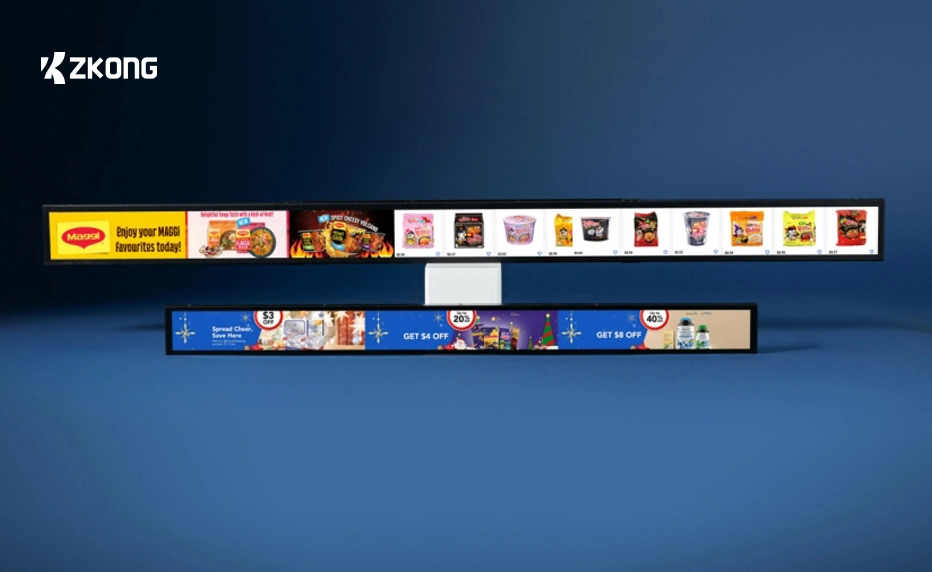
Digital signage helps retailers communicate more effectively than static posters.
Retailers use digital signage to:
Promote flash sales
Highlight new arrivals
Display nutritional information
Showcase seasonal campaigns
Guide customer navigation
Unlike printed materials, digital displays can update instantly based on:
Inventory status
Time-sensitive promotions
Seasonal campaigns
Regional preferences
This flexibility improves marketing effectiveness while reducing operational costs.
Labor shortages remain one of the biggest challenges facing retailers worldwide.
According to the National Retail Federation, retailers continue to face hiring and workforce management pressures, accelerating interest in automation technologies.
Large grocery stores require constant cleaning to maintain safety and customer satisfaction.
Autonomous cleaning robots can:
Clean during business hours
Reduce labor costs
Improve consistency
Maintain hygiene standards
Retail delivery robots can assist with:
Internal logistics
Store replenishment
Customer order transportation
Omnichannel fulfillment
As smart retail evolves, robotics will become an increasingly common component of store operations.
Technology investments should not operate in isolation.
The most successful grocery stores connect all systems through a centralized retail platform.
ESLs
Digital Signage
POS Systems
Inventory Management
Loyalty Programs
Analytics Platforms
Retailers gain:
Real-time visibility
Faster decision-making
Improved promotional execution
Better customer experiences
ZKONG's cloud architecture enables centralized management of connected retail devices across multiple store locations, helping retailers maintain consistency while reducing operational complexity.
Modern retail is driven by data.
The stores that perform best continuously measure and optimize customer interactions.
Shelf performance
Inventory turnover
Promotion effectiveness
Foot traffic
Conversion rates
“The future of retail belongs to businesses that can turn real-time data into real-time action.”
By leveraging smart retail technologies, grocery store operators can make faster and more informed decisions that directly impact profitability.
Manual pricing, inventory counting, and promotional execution limit scalability.
Waiting too long to adopt digital retail tools often results in higher operating costs later.
Modern consumers expect a seamless experience regardless of shopping channel.
The question is no longer simply how to start a grocery store.
The real question is how to build a grocery store that remains competitive for the next decade.
Successful retailers are increasingly investing in:
Electronic Shelf Labels
Digital Signage
Retail Analytics
Inventory Automation
Robotics
Cloud Retail Platforms
Together, these technologies create smarter operations, better customer experiences, and stronger business performance.
For entrepreneurs entering the retail industry in 2026, building a smart retail foundation from day one can provide a significant competitive advantage and position the business for long-term growth.


 Electronic Shelf Labels
  Digital Signage
  Cloud Platform
  ESL Accessory
  中文
中文 English
 日本語
日本語 français
 Deutsch